Sibley's and James Store Historic District

The National Park Service has not published a boundary polygon for this district; the map shows the listed properties inside it and the district's reference point.
Why it's listed
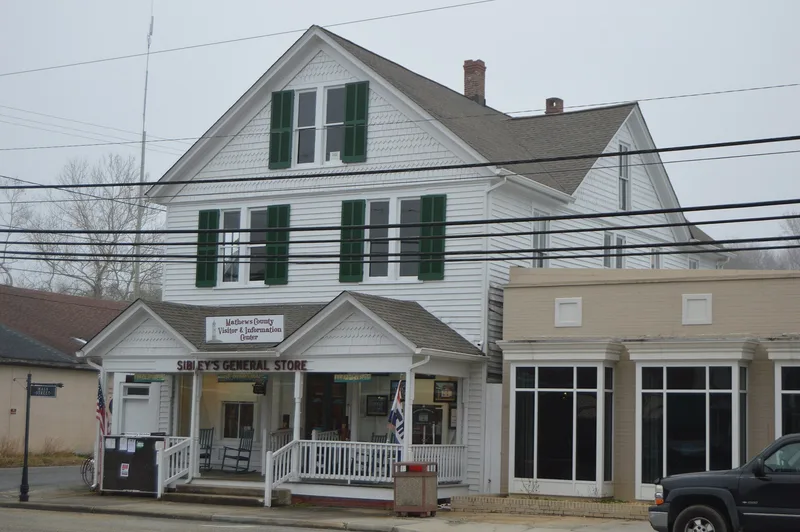
Three commercial buildings on a lot of under half an acre in downtown Mathews, Virginia, make up this small district. The oldest is the Old Thomas James Store, built about 1810, a one-story front-gabled frame building of roughly 15 by 25 feet. It has pit-sawn and hewn timbers, machine-cut nails, and traces of a retail room and counting room. It was probably moved from its original position facing Main Street. Behind Sibley's is a c.1840 one-story frame building with a full attic, joined to it by a later hyphen. Sibley's General Store, built in 1899, is a two-and-a-half story folk Victorian building with a full front porch and decorative wood shingles at the eaves. Together the buildings illustrate how rural stores changed over two centuries. They also reflect the part country stores and storekeepers played in Mathews, a county tied to the sea, whose slow growth helped preserve its rural village character.
Machine-generated summary. This summary was generated by a language model from the official nomination document and has not been reviewed line by line by an editor. It may contain errors. Check the source document before relying on any detail. Source: nomination document (PDF) · catalog entry. Generated October 2026 (model claude-sonnet-5-5, prompt v1.0-2026-10-29).
| Styles | Late Victorian; 19th-century Antebellum Store |
|---|---|
| Areas of significance | Commerce, Architecture |
| Acreage | 0.1 |
| Boundary source | not published |
| Full listing page | Sibley's and James Store Historic District (property record) |
What listing means for this property
This is a historic district. Buildings within its boundary are either contributing (they add to the district's significance) or non-contributing. Owners of contributing income-producing buildings can claim the 20% federal rehabilitation tax credit; homeowners should look at state credits. National Register districts impose no design review by themselves; a local historic district ordinance, if one exists, does (the difference explained).
General information, not legal or tax advice. Rules change; confirm with your State Historic Preservation Office or a qualified adviser.