Ridge Street Historic District

Why it's listed
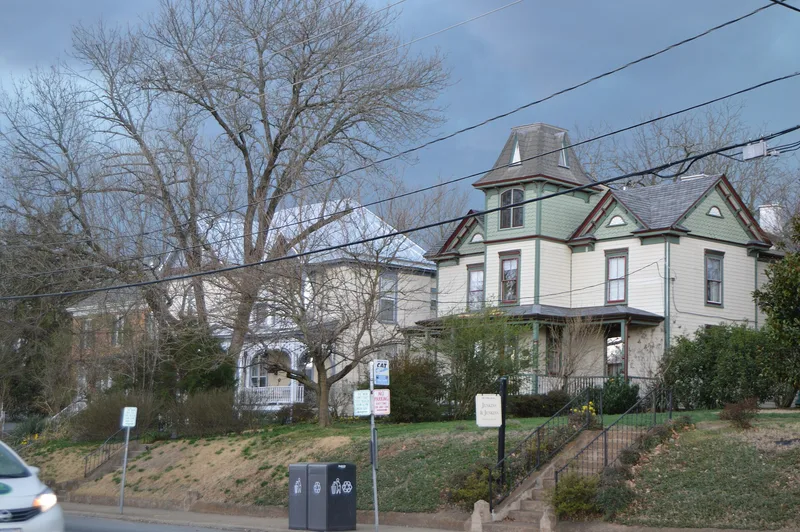
Ridge Street is a four-block residential district just south of downtown Charlottesville, covering about 20 acres and roughly 45 buildings. The land was once part of Alexander Garrett's Oak Hill estate and was subdivided around 1830. Growth was slow until after the Civil War, when many houses were built between 1870 and 1880, peaking in the 1890s with large Victorian homes for merchants and businessmen. Most are Victorian Vernacular, alongside Gothic Revival, Greek Revival, Second Empire and Colonial Revival buildings. The oldest house dates to about 1842, and 632 Ridge Street housed the Albemarle Military Institute until 1861. Wealthy families began leaving in the 1920s and 1930s, and many large houses became apartments. The street was racially integrated before the Civil War, and by the mid-1950s the area had become predominantly Black. Apart from a few modern intrusions, it has changed little physically since about 1900, which is the main reason it was listed.
Machine-generated summary. This summary was generated by a language model from the official nomination document and has not been reviewed line by line by an editor. It may contain errors. Check the source document before relying on any detail. Source: nomination document (PDF) · catalog entry. Generated October 2026 (model claude-sonnet-5-5, prompt v1.0-2026-10-29).
| Styles | Predominantly Victorian Vernacular, with Gothic Revival, Greek Revival, Second Empire, Queen Anne and Colonial Revival examples |
|---|---|
| Areas of significance | Commerce, Architecture |
| Acreage | 20 |
| Boundary source | NPS cultural-resource GIS polygon |
| Full listing page | Ridge Street Historic District (property record) |
What listing means for this property
This is a historic district. Buildings within its boundary are either contributing (they add to the district's significance) or non-contributing. Owners of contributing income-producing buildings can claim the 20% federal rehabilitation tax credit; homeowners should look at state credits. National Register districts impose no design review by themselves; a local historic district ordinance, if one exists, does (the difference explained).
General information, not legal or tax advice. Rules change; confirm with your State Historic Preservation Office or a qualified adviser.