Prince Georges County Courthouse Historic District

Why it's listed
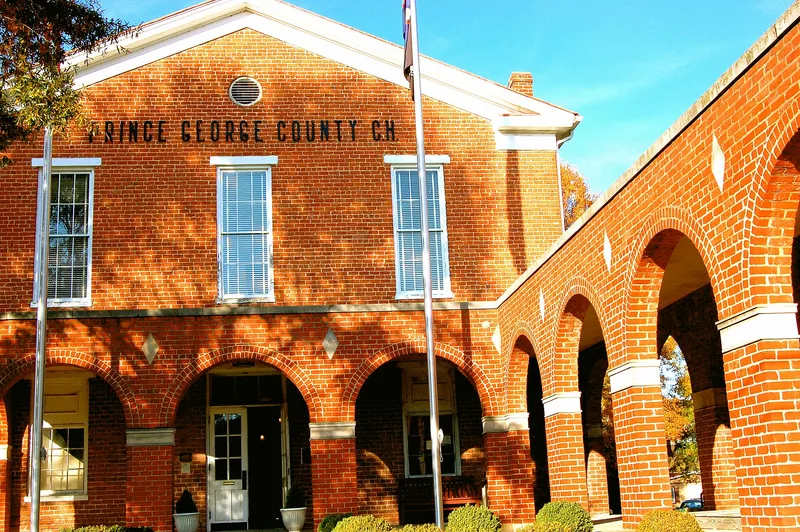
Prince George County's government center sits on both sides of a sharp bend in State Route 106. The district groups eleven contributing buildings, two noncontributing buildings and three memorials. The court buildings stand on the north side of the road, with privately owned buildings to the south, including an 1870s store and a Victorian residence. The brick 1883 courthouse, designed by F.L. Leavenworth, reflects temple-form courthouse design and is considered an early Colonial Revival example. Nearby are the 1900 clerk's office, now a library, a former jail, and a 1935 office building. A 1920s bungalow was later adapted for county offices. Memorials honor those lost in the Civil War, both World Wars, Korea and Vietnam. The district matters because the county lost its earlier courthouse when Union troops burned it in 1864. Court sessions then met in private homes and temporary buildings until a permanent seat was rebuilt, and the complex kept growing through 1952.
Machine-generated summary. This summary was generated by a language model from the official nomination document and has not been reviewed line by line by an editor. It may contain errors. Check the source document before relying on any detail. Source: nomination document (PDF) · catalog entry. Generated October 2026 (model claude-sonnet-5-5, prompt v1.0-2026-10-29).
| Period of significance | 1870-1952 |
|---|---|
| Styles | Greek Revival, Craftsman/Bungalow, Victorian (Colonial Revival described for the court buildings) |
| Areas of significance | Politics/Government |
| Acreage | 18 |
| Boundary source | NPS cultural-resource GIS polygon |
| Full listing page | Prince Georges County Courthouse Historic District (property record) |
What listing means for this property
This is a historic district. Buildings within its boundary are either contributing (they add to the district's significance) or non-contributing. Owners of contributing income-producing buildings can claim the 20% federal rehabilitation tax credit; homeowners should look at state credits. National Register districts impose no design review by themselves; a local historic district ordinance, if one exists, does (the difference explained).
General information, not legal or tax advice. Rules change; confirm with your State Historic Preservation Office or a qualified adviser.