Piedmont Mill Historic District

The National Park Service has not published a boundary polygon for this district; the map shows the listed properties inside it and the district's reference point.
Why it's listed
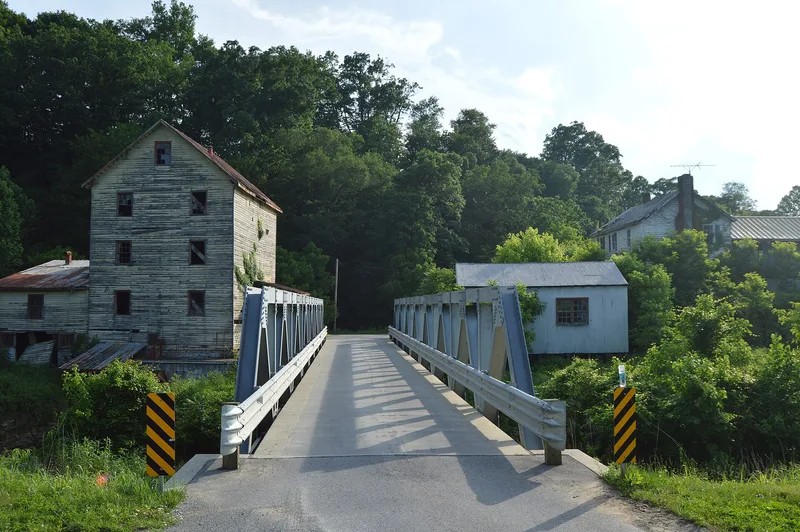
Along Maggodee Creek in northern Franklin County, Virginia, a small group of mill-related buildings and structures preserves the working landscape of a rural milling community. The main building is a three-story weatherboarded frame mill built about 1866 by Albert G. Martin. Its overshot waterwheel, millstones and roller equipment remain in place. In 1870 it was the highest-powered water-driven mill in the county, generating 45 horsepower. Benjamin Clements bought the property in 1923, and his family rebuilt the dam in 1936 and ran the mill until it closed in 1963. Nearby are a mill race, a concrete dam, two miller's houses (one once housing a general store, post office and dentist's office), stone retaining walls and outbuildings. A one-lane steel pony truss bridge built in 1929 by Roanoke Iron and Bridge Works carries Alean Road across the creek. The mill and houses are now largely unused, and the bridge has been closed to traffic since 2005.
Machine-generated summary. This summary was generated by a language model from the official nomination document and has not been reviewed line by line by an editor. It may contain errors. Check the source document before relying on any detail. Source: nomination document (PDF) · catalog entry. Generated October 2026 (model claude-sonnet-5-5, prompt v1.0-2026-10-29).
| Period of significance | c.1866 - 1963 |
|---|---|
| Styles | No style |
| Areas of significance | Architecture, Industry, Transportation |
| Acreage | 5.1 |
| Boundary source | not published |
| Full listing page | Piedmont Mill Historic District (property record) |
What listing means for this property
This is a historic district. Buildings within its boundary are either contributing (they add to the district's significance) or non-contributing. Owners of contributing income-producing buildings can claim the 20% federal rehabilitation tax credit; homeowners should look at state credits. National Register districts impose no design review by themselves; a local historic district ordinance, if one exists, does (the difference explained).
Noted as vacant in the nomination. Nomination documents can be decades old; current status may differ. If you are considering buying an empty listed property, read the due-diligence checklist.
General information, not legal or tax advice. Rules change; confirm with your State Historic Preservation Office or a qualified adviser.