Petersburg Old Town Historic District (Boundary Increase II)

The National Park Service has not published a boundary polygon for this district; the map shows the listed properties inside it and the district's reference point.
Why it's listed
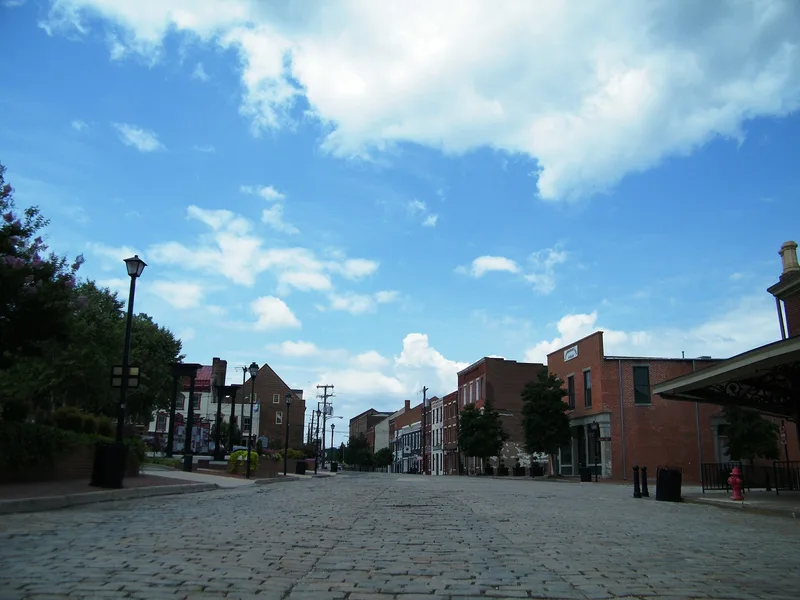
Fifteen buildings and structures at the eastern edge of Petersburg's Old Town make up this boundary increase, which runs between the Norfolk & Western rail line, East Bank Street and Interstate 95. Until the early twentieth century the land held working-class housing and food storage warehouses, including several peanut facilities. The houses are gone, but two brick warehouses, at 409 Fifth Street (about 1914) and 427 Bollingbrook Street (about 1935), survive with their brick detailing and painted business signs. Most other buildings are one-story concrete block shops and warehouses from the 1940s and 1950s, with overhead track doors, loading docks and metal-sash windows. A former service station at 203 Henry Street dates to the 1920s. Together they show the move from residential and commodity-processing uses to light industry and commerce. Completion of Interstate 95 in 1958 stopped new development and fixed the eastern edge of historic downtown. The area was added to the district for its architecture, commerce and industry, with a period of significance of 1914 to 1958.
Machine-generated summary. This summary was generated by a language model from the official nomination document and has not been reviewed line by line by an editor. It may contain errors. Check the source document before relying on any detail. Source: nomination document (PDF) · catalog entry. Generated October 2026 (model claude-sonnet-5-5, prompt v1.0-2026-10-29).
| Period of significance | 1914-1958 |
|---|---|
| Styles | Late 19th and Early 20th Century American Movements: Commercial Style |
| Areas of significance | Architecture, Commerce, Industry |
| Acreage | 6.7 |
| Boundary source | not published |
| Full listing page | Petersburg Old Town Historic District (Boundary Increase II) (property record) |
What listing means for this property
This is a historic district. Buildings within its boundary are either contributing (they add to the district's significance) or non-contributing. Owners of contributing income-producing buildings can claim the 20% federal rehabilitation tax credit; homeowners should look at state credits. National Register districts impose no design review by themselves; a local historic district ordinance, if one exists, does (the difference explained).
General information, not legal or tax advice. Rules change; confirm with your State Historic Preservation Office or a qualified adviser.