Petersburg Courthouse Historic District

Why it's listed
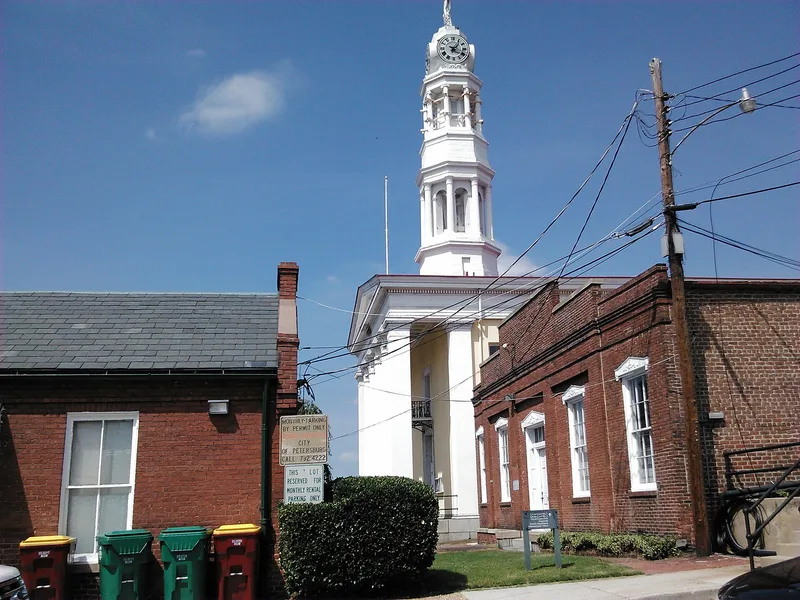
Downtown Petersburg's central business and governmental district occupies high ground south of the city's earliest commercial area near the Appomattox River. Its centerpiece is the Hustings Courthouse, built 1838-1840 in Greek Revival style to a design by New York architect Calvin Pollard and visible across the downtown skyline. Nearby stand the 1859 Customs House by Ammi B. Young, Tabb Street Presbyterian Church by Thomas U. Walter, and St. Paul's Episcopal Church. Around them are brick commercial rows in Federal and Italianate styles, early twentieth-century banks, department stores, tobacco warehouses and factories, and a few antebellum houses. Cast-iron storefront details, granite retaining walls and Carrara-glass storefront renovations add texture. The area shifted from largely residential to commercial after the 1850s, when rail transport lessened reliance on the river. Parking lots, modern office buildings and altered storefronts intrude, but most blocks keep their original upper facades, so the district still shows how downtown Petersburg's commercial and architectural character developed over about a century and a half.
Machine-generated summary. This summary was generated by a language model from the official nomination document and has not been reviewed line by line by an editor. It may contain errors. Check the source document before relying on any detail. Source: nomination document (PDF) · catalog entry. Generated October 2026 (model claude-sonnet-5-5, prompt v1.0-2026-10-29).
| Styles | Federal, Greek Revival, Italianate, Renaissance Revival, Commercial Style |
|---|---|
| Areas of significance | Commerce, Military, Transportation, Politics/Government, Architecture |
| Acreage | 36.2 |
| Boundary source | NPS cultural-resource GIS polygon |
| Full listing page | Petersburg Courthouse Historic District (property record) |
What listing means for this property
This is a historic district. Buildings within its boundary are either contributing (they add to the district's significance) or non-contributing. Owners of contributing income-producing buildings can claim the 20% federal rehabilitation tax credit; homeowners should look at state credits. National Register districts impose no design review by themselves; a local historic district ordinance, if one exists, does (the difference explained).
General information, not legal or tax advice. Rules change; confirm with your State Historic Preservation Office or a qualified adviser.