New Market Historic District

Why it's listed
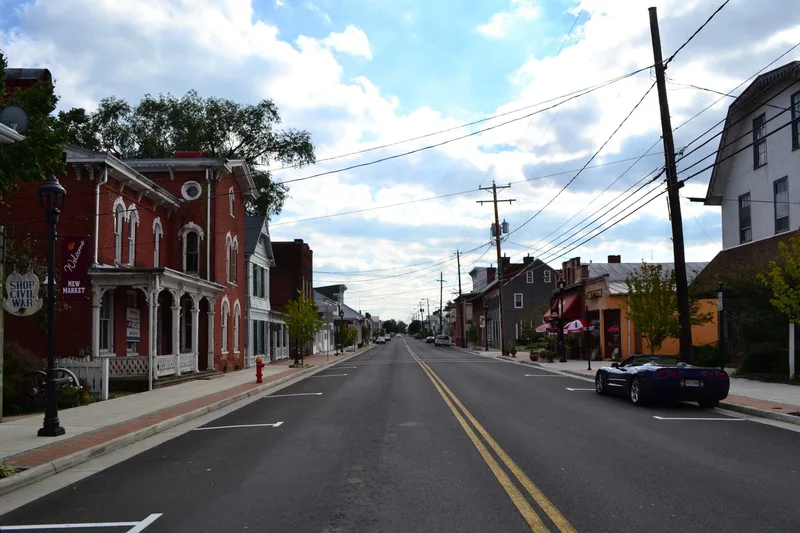
New Market is a small Shenandoah Valley town stretching just under a mile along U.S. Route 11, the old Valley Pike. It began at a crossroads where John Sevier opened a trader's store in 1761, and Peter Palsel laid out the town in 1785. It was officially named New Market in 1796. Most buildings are two-story brick or frame structures with gable roofs set at the front of their lots, and about two thirds of the roughly one hundred along the main road date from the nineteenth century. Notable buildings include the Strayer House, later the Lee-Jackson Hotel, a limestone Henkel family house, a log store, and Emmanuel Lutheran Church. The Henkel Press, founded in 1806, is the oldest Lutheran press in America. The town also figured in the Civil War battle of May 15, 1864. Growth stopped in the late nineteenth century when the Valley Pike traffic dwindled and the railroad bypassed it, which preserved the town's early character.
Machine-generated summary. This summary was generated by a language model from the official nomination document and has not been reviewed line by line by an editor. It may contain errors. Check the source document before relying on any detail. Source: nomination document (PDF) · catalog entry. Generated October 2026 (model claude-sonnet-5-5, prompt v1.0-2026-10-29).
| Styles | Mixed 18th and 19th century town architecture: Federal, Georgian, Italianate, Romanesque Revival, and log and frame vernacular buildings |
|---|---|
| Areas of significance | Community Planning and Development, Commerce, Military, Literature, Architecture |
| Acreage | 130 |
| Boundary source | NPS cultural-resource GIS polygon |
| Full listing page | New Market Historic District (property record) |
What listing means for this property
This is a historic district. Buildings within its boundary are either contributing (they add to the district's significance) or non-contributing. Owners of contributing income-producing buildings can claim the 20% federal rehabilitation tax credit; homeowners should look at state credits. National Register districts impose no design review by themselves; a local historic district ordinance, if one exists, does (the difference explained).
General information, not legal or tax advice. Rules change; confirm with your State Historic Preservation Office or a qualified adviser.