New Castle Historic District

The National Park Service has not published a boundary polygon for this district; the map shows the listed properties inside it and the district's reference point.
Why it's listed
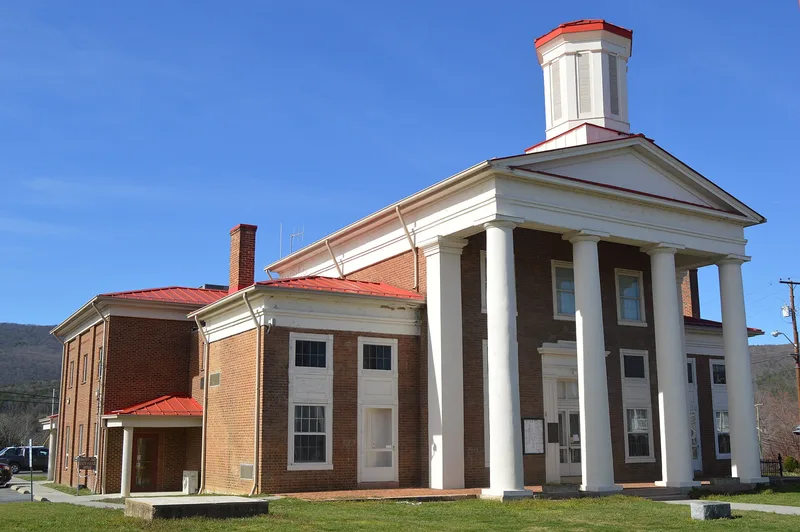
Five brick buildings along Court Street make up the core of New Castle, the seat of Craig County in western Virginia. The courthouse, the sheriff's house with its old jail, and the Central Hotel were all begun in 1851, when the county was formed. The courthouse is a temple-form Greek Revival building with a two-story Doric portico and a wooden cupola, and it follows the design of the Botetourt County Courthouse in Fincastle. Two late-nineteenth century buildings, the First National Bank and the Layman Insurance Agency, show how the court group drew business to the town. Together the buildings share brick materials and a consistent scale. Local tradition links saber cuts on the courtroom stair balusters to Union soldiers passing through during the Civil War. New Castle began as a frontier fort in 1756 and was incorporated as a town in 1890. The district is regarded as an unusually complete ante-bellum county seat complex.
Machine-generated summary. This summary was generated by a language model from the official nomination document and has not been reviewed line by line by an editor. It may contain errors. Check the source document before relying on any detail. Source: nomination document (PDF) · catalog entry. Generated October 2026 (model claude-sonnet-5-5, prompt v1.0-2026-10-29).
| Period of significance | 19th Century |
|---|---|
| Styles | Greek Revival (courthouse); Eastlake detailing on the bank |
| Areas of significance | Commerce, Politics/Government, Architecture, Social History |
| Acreage | 1.5 |
| Boundary source | not published |
| Full listing page | New Castle Historic District (property record) |
What listing means for this property
This is a historic district. Buildings within its boundary are either contributing (they add to the district's significance) or non-contributing. Owners of contributing income-producing buildings can claim the 20% federal rehabilitation tax credit; homeowners should look at state credits. National Register districts impose no design review by themselves; a local historic district ordinance, if one exists, does (the difference explained).
General information, not legal or tax advice. Rules change; confirm with your State Historic Preservation Office or a qualified adviser.