Monroe Park Historic District

Why it's listed
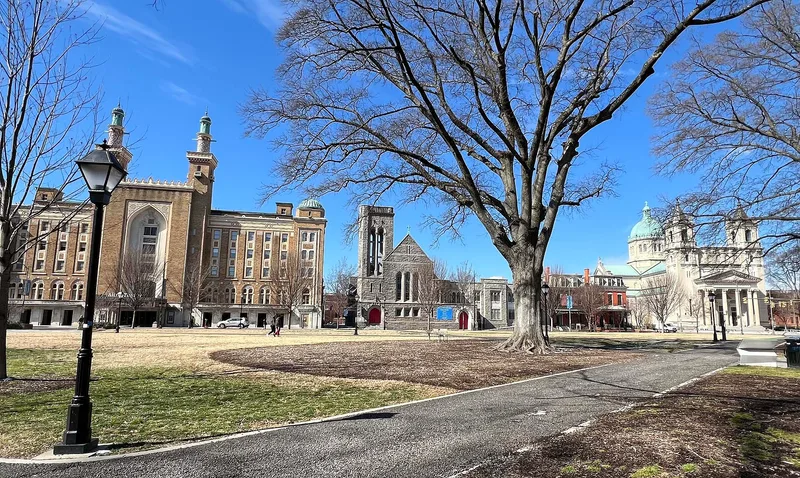
Monroe Park Historic District occupies about 21 acres in central Richmond, between downtown and a dense town house neighborhood. Its core is a five-sided public park on land the city bought in 1851. It served as a fairground and Civil War camp before being developed for recreation in the 1870s. Radial walks lead to a four-tier cast-iron fountain made about 1903, and the park holds statues of William Carter Wickham and Joseph Bryan and an octagonal Checkers House of 1939. Facing the park are late 19th-century town houses, Grace and Holy Trinity Church (1895), the Cathedral of the Sacred Heart (1906), the Moorish Mosque Auditorium (1926), and two twelve-story Jacobean Revival apartment buildings from the 1920s. The district was listed for this unusual meeting of minarets, domes, towers and mansard roofs around a shared green space. Sixteen buildings and five objects are counted, and two buildings are non-contributing.
Machine-generated summary. This summary was generated by a language model from the official nomination document and has not been reviewed line by line by an editor. It may contain errors. Check the source document before relying on any detail. Source: nomination document (PDF) · catalog entry. Generated October 2026 (model claude-sonnet-5-5, prompt v1.0-2026-10-29).
| Styles | Eclectic mix: Gothic Revival, Italian Renaissance, Moorish, Second Empire, Italianate, Jacobean Revival, Georgian Revival, Colonial Revival |
|---|---|
| Areas of significance | Architecture |
| Acreage | 21 |
| Boundary source | NPS cultural-resource GIS polygon |
| Full listing page | Monroe Park Historic District (property record) |
What listing means for this property
This is a historic district. Buildings within its boundary are either contributing (they add to the district's significance) or non-contributing. Owners of contributing income-producing buildings can claim the 20% federal rehabilitation tax credit; homeowners should look at state credits. National Register districts impose no design review by themselves; a local historic district ordinance, if one exists, does (the difference explained).
General information, not legal or tax advice. Rules change; confirm with your State Historic Preservation Office or a qualified adviser.