Main Street Banking Historic District (Boundary Increase)

The National Park Service has not published a boundary polygon for this district; the map shows the listed properties inside it and the district's reference point.
Why it's listed
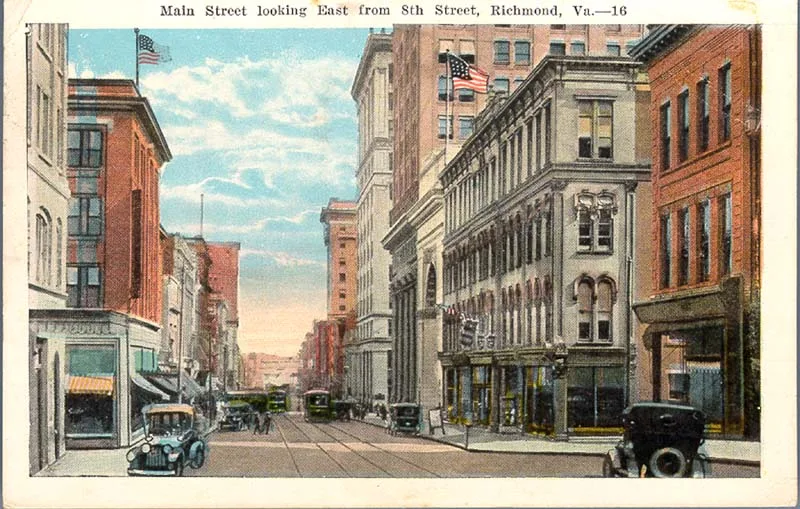
East Main Street in downtown Richmond, between 7th and Governor (13th) Streets, has served as the city's banking center since the Bank of Virginia and the Farmer's Bank built adjoining offices there in 1817. The 1865 Evacuation Fire destroyed nearly every antebellum building in the area except the 1858 Customs House, designed by Ammi Burnham Young. Rebuilding began almost immediately, and the south side of the street gained a continuous row of cast-iron fronts inspired by Venetian palazzi, including the Stearns Building and the Virginia Fire and Marine Insurance building, both linked to designer George H. Johnson. Around 1900 the streetscape changed again with steel-frame skyscrapers, among them the twelve-story Mutual Building, the Travelers' Building and the nineteen-story First National Bank Building of 1912, then the tallest structure in the city. Hotels, a Richardsonian Romanesque bank and later Neoclassical banks add variety. The district contains twenty-one contributing buildings, six already individually listed.
Machine-generated summary. This summary was generated by a language model from the official nomination document and has not been reviewed line by line by an editor. It may contain errors. Check the source document before relying on any detail. Source: nomination document (PDF). Generated October 2026 (model claude-sonnet-5-5, prompt v1.0-2026-10-29).
| Styles | Late Victorian (Italianate, Renaissance Revival, Romanesque); Beaux Arts, Classical Revival; Commercial Style; Modern Movement (Art Deco, Post-Modern) |
|---|---|
| Areas of significance | Architecture, Commerce, Economics, Law |
| Acreage | 2.5 |
| Boundary source | not published |
| Full listing page | Main Street Banking Historic District (Boundary Increase) (property record) |
What listing means for this property
This is a historic district. Buildings within its boundary are either contributing (they add to the district's significance) or non-contributing. Owners of contributing income-producing buildings can claim the 20% federal rehabilitation tax credit; homeowners should look at state credits. National Register districts impose no design review by themselves; a local historic district ordinance, if one exists, does (the difference explained).
General information, not legal or tax advice. Rules change; confirm with your State Historic Preservation Office or a qualified adviser.