Lancaster Court House Historic District

Why it's listed
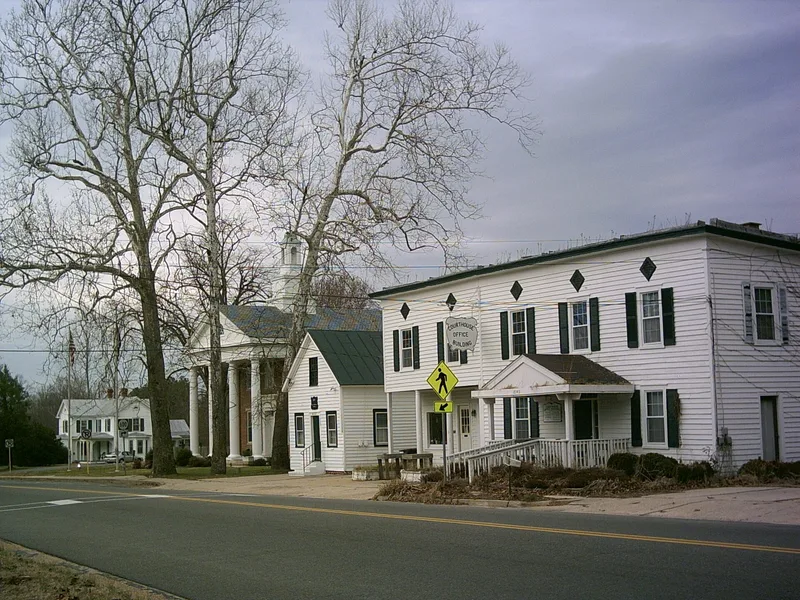
Lancaster Court House is a small county-seat village stretched for about three-quarters of a mile along Route 3 on Virginia's Northern Neck. Its core is a courthouse complex: a courthouse built in 1860-61 by Edward O. Robinson and given a portico in 1937, an old clerk's office from 1745 with an 1833 addition, and a jail from 1743 with an 1820 addition, now a museum and library. An 1872 marble Confederate monument on the green is believed to be the first such memorial erected in Virginia. Around the green are a ca. 1800 tavern, an antebellum post office, an 1884 Carpenter-Gothic church, a ca. 1900 store, and frame houses from the mid-19th to early 20th centuries. Farm fields surround the village and keep its low density and rural scale. The district was listed for the way these buildings, with few modern intrusions, show the character of a rural Virginia courthouse town, and for county records that run unbroken from 1651.
Machine-generated summary. This summary was generated by a language model from the official nomination document and has not been reviewed line by line by an editor. It may contain errors. Check the source document before relying on any detail. Source: nomination document (PDF) · catalog entry. Generated October 2026 (model claude-sonnet-5-5, prompt v1.0-2026-10-29).
| Period of significance | 1700-1799, 1800-1899, 1900- (specific dates: Various) |
|---|---|
| Styles | Mixed: Classical Revival courthouse, Federal and late Federal, Queen Anne, Romantic Revival, Carpenter-Gothic church, and vernacular |
| Areas of significance | Politics/Government, Architecture |
| Acreage | 39 |
| Boundary source | NPS cultural-resource GIS polygon |
| Full listing page | Lancaster Court House Historic District (property record) |
What listing means for this property
This is a historic district. Buildings within its boundary are either contributing (they add to the district's significance) or non-contributing. Owners of contributing income-producing buildings can claim the 20% federal rehabilitation tax credit; homeowners should look at state credits. National Register districts impose no design review by themselves; a local historic district ordinance, if one exists, does (the difference explained).
General information, not legal or tax advice. Rules change; confirm with your State Historic Preservation Office or a qualified adviser.