Laburnum Park Historic District

Why it's listed
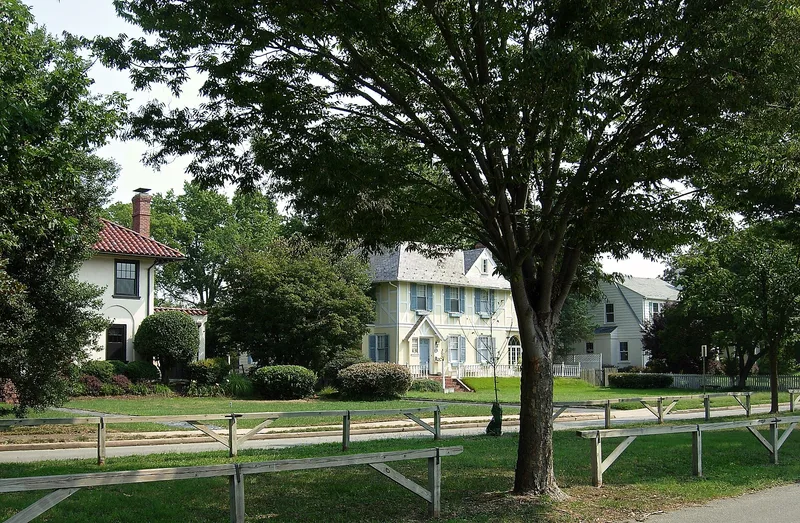
Laburnum Park is a residential suburb of about 116 acres in northwest Richmond, planned around 1919 on a grid of wide avenues. Grassy medians with mature shade trees, deep setbacks, half-acre lots and original cast-metal street signs give it a designed character. Most of its roughly 230 houses are two stories, in brick or frame, and Colonial Revival dominates, with many Craftsman and Tudor Revival examples and a few Mission and French Renaissance designs. Notable buildings include the 1908 Laburnum House, the 1911 Hermitage mansion and Laburnum Court, 24 cooperatively owned houses designed by Charles M. Robinson in 1919 to promote lot sales. Institutions along Westwood Avenue include a nursing home, a school campus and the former Richmond Memorial Hospital, completed in 1957. Two markers recall the area's earlier history: a turnpike mile marker and a Civil War defenses plaque. The district was listed for its intact suburban landscape and architectural variety.
Machine-generated summary. This summary was generated by a language model from the official nomination document and has not been reviewed line by line by an editor. It may contain errors. Check the source document before relying on any detail. Source: nomination document (PDF) · catalog entry. Generated October 2026 (model claude-sonnet-5-5, prompt v1.0-2026-10-29).
| Styles | Colonial Revival, Bungalow/Craftsman, Tudor Revival, Queen Anne, Classical Revival, Mission/Spanish Colonial Revival, French Renaissance, Late Gothic Revival, Modern Movement |
|---|---|
| Areas of significance | Architecture, Community Planning and Development, Education, Health/Medicine, Religion |
| Acreage | 116 |
| Boundary source | NPS cultural-resource GIS polygon |
| Full listing page | Laburnum Park Historic District (property record) |
What listing means for this property
This is a historic district. Buildings within its boundary are either contributing (they add to the district's significance) or non-contributing. Owners of contributing income-producing buildings can claim the 20% federal rehabilitation tax credit; homeowners should look at state credits. National Register districts impose no design review by themselves; a local historic district ordinance, if one exists, does (the difference explained).
General information, not legal or tax advice. Rules change; confirm with your State Historic Preservation Office or a qualified adviser.