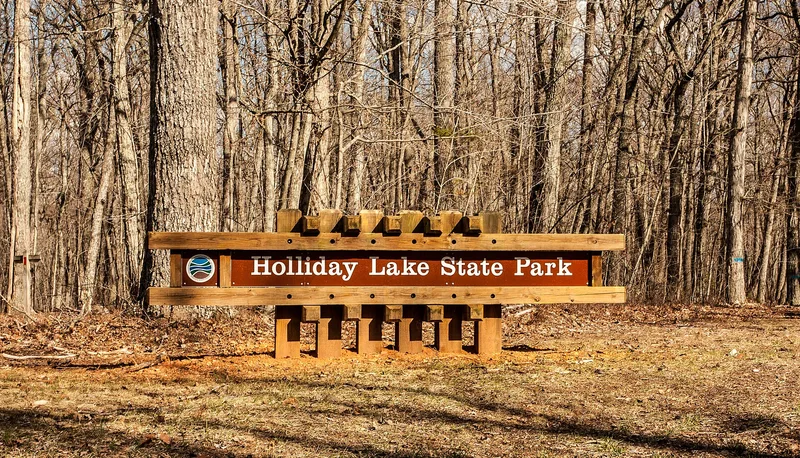
Holliday Lake State Park

Why it's listed
Holliday Lake State Park occupies about 255 acres in the Appomattox-Buckingham State Forest in Appomattox County, Virginia. Its center is a 150-acre manmade lake, reached by a long entry drive that follows the land's contours. The park began as one of four recreational development areas created by the Virginia Division of Forestry, working with the Civilian Conservation Corps and Works Progress Administration during the Great Depression. It was not built to strict National Park Service standards, yet it shares their approach: separate activity areas, a water feature as the organizing element, and buildings of natural materials. Surviving historic resources include a Rustic log picnic shelter from the 1930s, a brick well house of about 1939, the dam, spillway and bridge, slate drainage culverts, a rubble retaining wall and the circulation system. Campground, offices, restrooms, boathouses and residences added from the 1970s onward are counted as noncontributing. The park became Holliday Lake State Park in 1972 and remains a recreation area.
Machine-generated summary. This summary was generated by a language model from the official nomination document and has not been reviewed line by line by an editor. It may contain errors. Check the source document before relying on any detail. Source: nomination document (PDF) · catalog entry. Generated October 2026 (model claude-sonnet-5-5, prompt v1.0-2026-10-29).
| Styles | Other/Rustic; Other/Post-Modern |
|---|---|
| Areas of significance | Architecture, Entertainment/Recreation, Landscape Architecture |
| Acreage | 255.3 |
| Boundary source | NPS cultural-resource GIS polygon |
| Full listing page | Holliday Lake State Park (property record) |
What listing means for this property
This is a historic district. Buildings within its boundary are either contributing (they add to the district's significance) or non-contributing. Owners of contributing income-producing buildings can claim the 20% federal rehabilitation tax credit; homeowners should look at state credits. National Register districts impose no design review by themselves; a local historic district ordinance, if one exists, does (the difference explained).
General information, not legal or tax advice. Rules change; confirm with your State Historic Preservation Office or a qualified adviser.