Fort Norfolk

The National Park Service has not published a boundary polygon for this district; the map shows the listed properties inside it and the district's reference point.
Why it's listed
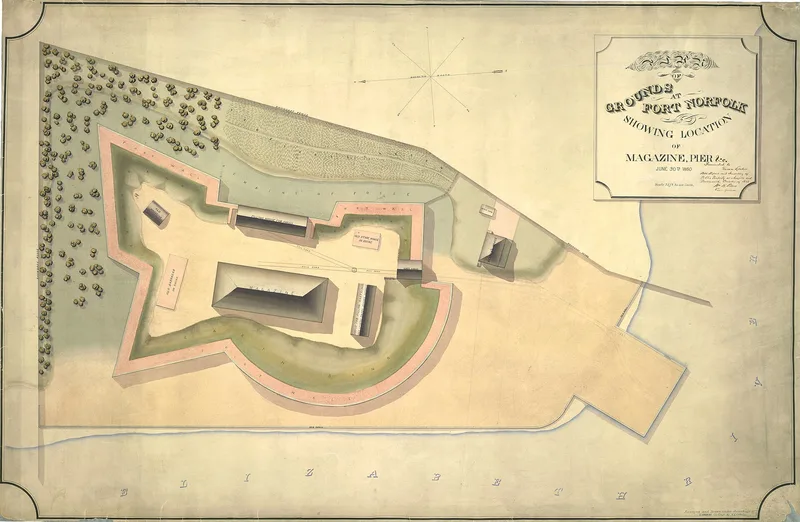
Fort Norfolk occupies a site on the north shore of the Elizabeth River in Norfolk, Virginia. Citizens of Norfolk began the fort during the Revolutionary War on private land, and Congress bought it, with federal ownership dating from 21 May 1795. Its brick wall was built in 1809. The fort was manned during the 1807 war scare and the War of 1812, when its garrison joined the 1813 defeat of the British at Craney Island. During the Civil War a battery was placed there, and the Army and Navy later disputed control until the Navy took it in 1863. The Army Corps of Engineers Norfolk District moved in during 1923 and has used part or all of the facilities since. Surviving historic structures include the powder magazine, enlisted men's quarters, officers' mess, officers' quarters, guard house and the brick wall, alongside later office buildings, some added around 1942. The grounds are still in government use.
Machine-generated summary. This summary was generated by a language model from the official nomination document and has not been reviewed line by line by an editor. It may contain errors. Check the source document before relying on any detail. Source: nomination document (PDF) · catalog entry. Generated October 2026 (model claude-sonnet-5-5, prompt v1.0-2026-10-29).
| Period of significance | late 1700s to present |
|---|---|
| Areas of significance | Military |
| Acreage | 4 |
| Boundary source | not published |
| Full listing page | Fort Norfolk (property record) |
What listing means for this property
This is a historic district. Buildings within its boundary are either contributing (they add to the district's significance) or non-contributing. Owners of contributing income-producing buildings can claim the 20% federal rehabilitation tax credit; homeowners should look at state credits. National Register districts impose no design review by themselves; a local historic district ordinance, if one exists, does (the difference explained).
General information, not legal or tax advice. Rules change; confirm with your State Historic Preservation Office or a qualified adviser.