Federal Hill Historic District
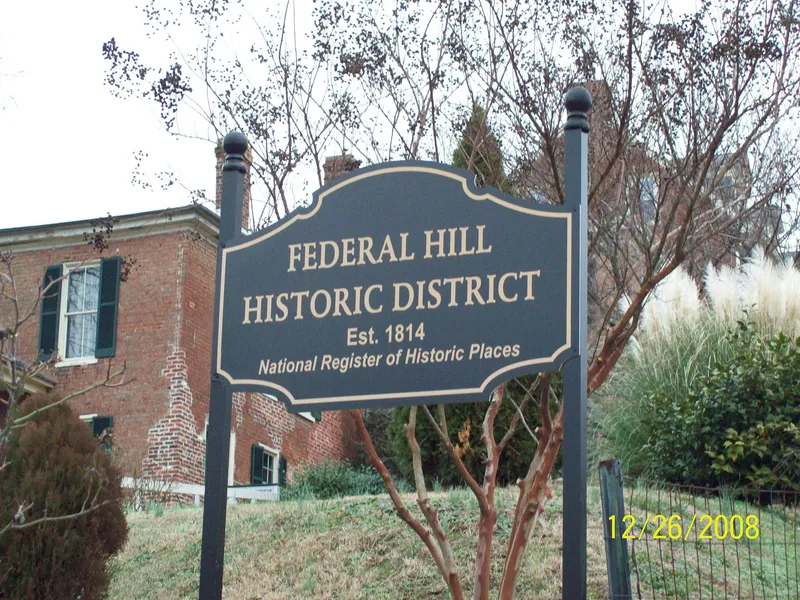

Why it's listed
Federal Hill is a dozen-block residential neighborhood on one of Lynchburg's seven hills, set apart from the commercial area by a deep valley. Its tree-shaded streets keep early patterned brick sidewalks, slate walks, granite curbs and iron fences. Mostly free-standing brick and frame houses of similar scale line the grid, dating from the early 19th century to the early 20th. The district's most prized buildings are a group of Federal-style brick townhouses, many built before the area was annexed from Campbell County in 1819, including the Ford, Carrington, Otey and Holcombe houses. Later additions include the Greek Revival Winfree and Langhorne houses, three French Second Empire houses on Harrison Street, and many frame houses with Eastlake porches. Merchants and civic leaders, rather than industrialists, were the typical residents. The 8th Street Baptist Church of 1899 and the former Frank Roane School add notable non-residential architecture. The mix of styles, held together by consistent scale and massing, gives the district its character.
Machine-generated summary. This summary was generated by a language model from the official nomination document and has not been reviewed line by line by an editor. It may contain errors. Check the source document before relying on any detail. Source: nomination document (PDF) · catalog entry. Generated October 2026 (model claude-sonnet-5-5, prompt v1.0-2026-10-29).
| Period of significance | 1800-1899, 1900- |
|---|---|
| Styles | Federal, Greek Revival, French Second Empire, Queen Anne, Eastlake, Edwardian eclectic, Romanesque Revival |
| Areas of significance | Architecture, Social History |
| Acreage | 33 |
| Boundary source | NPS cultural-resource GIS polygon |
| Full listing page | Federal Hill Historic District (property record) |
What listing means for this property
This is a historic district. Buildings within its boundary are either contributing (they add to the district's significance) or non-contributing. Owners of contributing income-producing buildings can claim the 20% federal rehabilitation tax credit; homeowners should look at state credits. National Register districts impose no design review by themselves; a local historic district ordinance, if one exists, does (the difference explained).
General information, not legal or tax advice. Rules change; confirm with your State Historic Preservation Office or a qualified adviser.