Church Hill North Historic District

Why it's listed
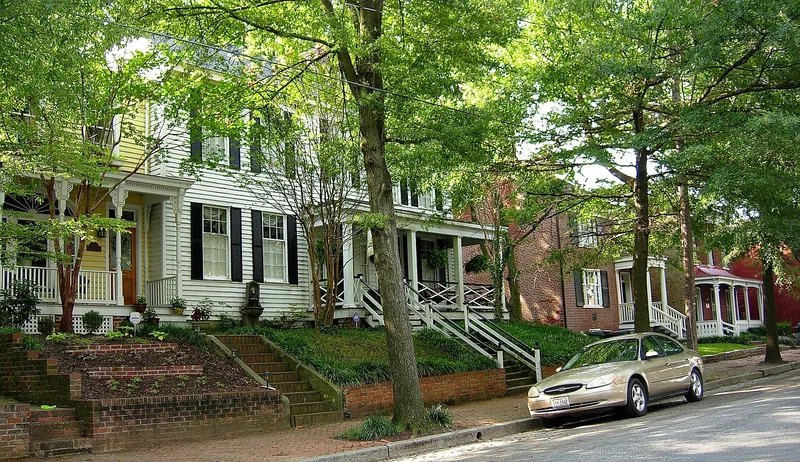
Church Hill North is a Richmond neighborhood of more than twenty-five blocks, bounded by M Street and Jefferson Avenue, Twenty-ninth Street, and the adjacent St. John's Church Historic District. Over ninety percent of its homes, shops and institutional buildings predate 1900, and the scale, materials, setbacks and landscaping remain consistent. No single style dominates. Twelve Federal-style houses, mostly along North 27th Street, date from 1810 to 1839, and the district includes the oldest commercial building in the city, the Wills store of 1813. Greek Revival was the most popular choice, with about 200 structures built between 1840 and 1865, including the temple-form Leigh Street Baptist Church, designed by Samuel Sloan in 1853. Italianate houses, slate-roofed Second Empire rows, Stick-style rental houses built by the Billups family, Queen Anne rowhouses, Colonial Revival homes, Classical Revival lodges and an Art Deco theater add variety. Together these buildings form a harmonious, largely unspoiled streetscape, which supports the district's recognition for its architecture.
Machine-generated summary. This summary was generated by a language model from the official nomination document and has not been reviewed line by line by an editor. It may contain errors. Check the source document before relying on any detail. Source: nomination document (PDF) · catalog entry. Generated October 2026 (model claude-sonnet-5-5, prompt v1.0-2026-10-29).
| Styles | Federal, Greek Revival, Italianate, Second Empire, Stick, Queen Anne, Classical Revival, Colonial Revival, Art Deco |
|---|---|
| Areas of significance | Architecture |
| Acreage | 70 |
| Boundary source | NPS cultural-resource GIS polygon |
| Full listing page | Church Hill North Historic District (property record) |
What listing means for this property
This is a historic district. Buildings within its boundary are either contributing (they add to the district's significance) or non-contributing. Owners of contributing income-producing buildings can claim the 20% federal rehabilitation tax credit; homeowners should look at state credits. National Register districts impose no design review by themselves; a local historic district ordinance, if one exists, does (the difference explained).
General information, not legal or tax advice. Rules change; confirm with your State Historic Preservation Office or a qualified adviser.