Burrland Farm Historic District

The National Park Service has not published a boundary polygon for this district; the map shows the listed properties inside it and the district's reference point.
Why it's listed
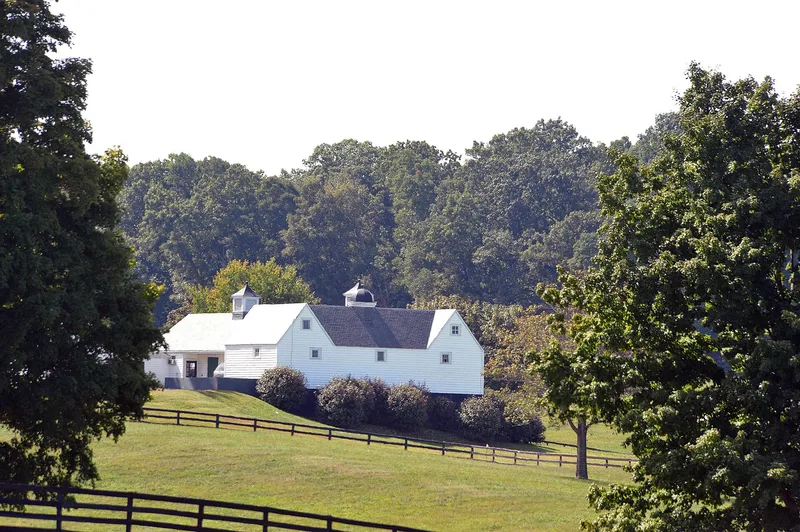
Burrland Farm is a 458-acre thoroughbred breeding and training farm one mile south of Middleburg, Virginia. William Ziegler, Jr., a New York businessman, bought the property in 1926 and built most of the present complex between 1927 and 1932. The district includes a training barn, polo barn, stallion and broodmare barns, houses, garages, a springhouse, and a three-quarter-mile racetrack. The white, slate-roofed frame buildings with cupolas share a consistent Georgian Revival design. The 28-stall training barn, with an indoor oval track and an octagonal cupola, is the centerpiece. Although no drawings survive, the stables are attributed to architect William Lawrence Bottomley, who also designed the large addition to the Noland family's house at Burrland. That mansion was burned in the 1960s. The farm hosted a large race meet and horse show in 1931 and was regarded as one of the best-equipped stud farms on the Atlantic Seaboard. Its pastures, paddocks and stone fences remain, protected by a conservation easement.
Machine-generated summary. This summary was generated by a language model from the official nomination document and has not been reviewed line by line by an editor. It may contain errors. Check the source document before relying on any detail. Source: nomination document (PDF) · catalog entry. Generated October 2026 (model claude-sonnet-5-5, prompt v1.0-2026-10-29).
| Styles | Colonial Revival (Georgian Revival) |
|---|---|
| Areas of significance | Agriculture, Architecture, Entertainment/Recreation |
| Acreage | 458 |
| Boundary source | not published |
| Full listing page | Burrland Farm Historic District (property record) |
What listing means for this property
This is a historic district. Buildings within its boundary are either contributing (they add to the district's significance) or non-contributing. Owners of contributing income-producing buildings can claim the 20% federal rehabilitation tax credit; homeowners should look at state credits. National Register districts impose no design review by themselves; a local historic district ordinance, if one exists, does (the difference explained).
General information, not legal or tax advice. Rules change; confirm with your State Historic Preservation Office or a qualified adviser.