Burke's Garden Central Church And Cemetery

The National Park Service has not published a boundary polygon for this district; the map shows the listed properties inside it and the district's reference point.
Why it's listed
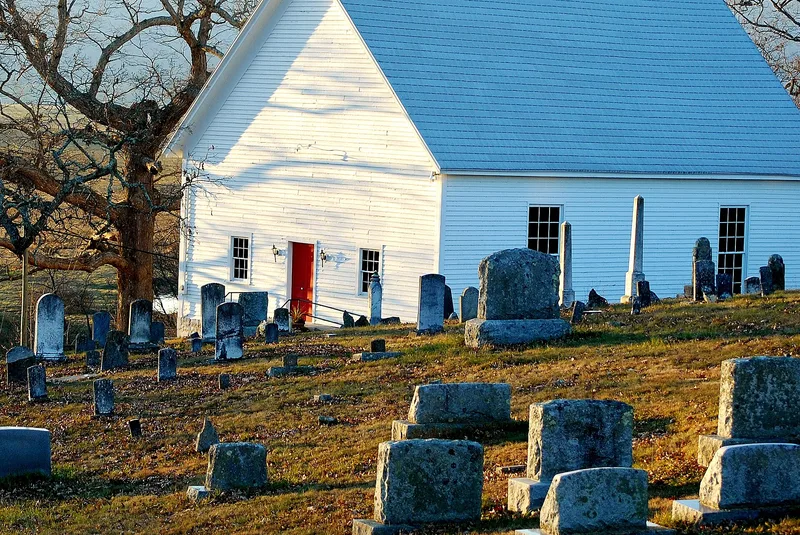
Burke's Garden Central Church and Cemetery sit along a low ridge in a natural bowl atop Garden Mountain in eastern Tazewell County, Virginia. The present church, built in 1875, is a plain rectangular frame building with a steep gable roof and 6/6 sash windows. The cemetery, with burials beginning in 1827, is the main point of interest. It contains thick sandstone markers decorated on both sides with sunflowers, stars, pinwheels and hearts. Their style suggests one unknown carver also made stones at Zion and Kimberling churches in Wythe County and Sharon Church in Bland County. This ties the site to German settlers who reached this far corner of Southwest Virginia in the late 18th century. The church began as a shared building among denominations and the cemetery has always been open to all. Later markers include a neo-Grec obelisk from 1889 and handmade concrete stones made by D. G. Heninger, showing that local handcraft continued into the twentieth century.
Machine-generated summary. This summary was generated by a language model from the official nomination document and has not been reviewed line by line by an editor. It may contain errors. Check the source document before relying on any detail. Source: nomination document (PDF) · catalog entry. Generated October 2026 (model claude-sonnet-5-5, prompt v1.0-2026-10-29).
| Period of significance | 1800-1899 |
|---|---|
| Styles | 19th-century vernacular, with no stylistic detailing |
| Areas of significance | Art, European, Exploration/Settlement, Religion |
| Acreage | 2.5 |
| Boundary source | not published |
| Full listing page | Burke's Garden Central Church And Cemetery (property record) |
What listing means for this property
This is a historic district. Buildings within its boundary are either contributing (they add to the district's significance) or non-contributing. Owners of contributing income-producing buildings can claim the 20% federal rehabilitation tax credit; homeowners should look at state credits. National Register districts impose no design review by themselves; a local historic district ordinance, if one exists, does (the difference explained).
General information, not legal or tax advice. Rules change; confirm with your State Historic Preservation Office or a qualified adviser.