Albemarle County Courthouse Historic District

Why it's listed
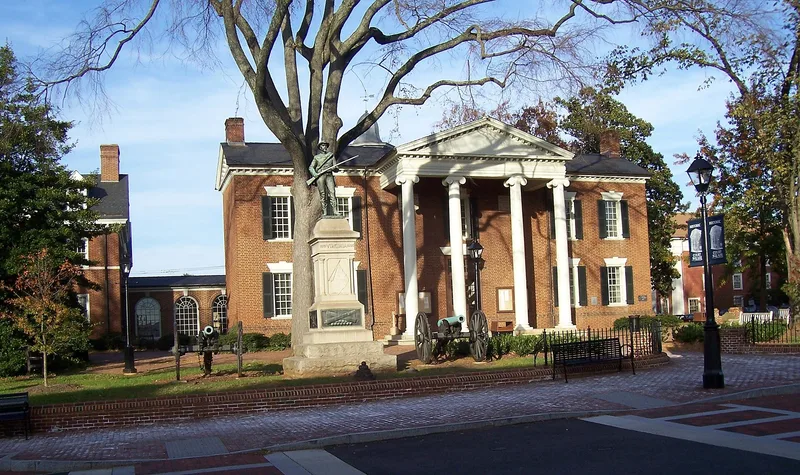
Court Square sits near the center of Charlottesville, Virginia, and forms a historic district of brick houses, public buildings and a landscaped green. The T-shaped Albemarle County Court House anchors the east side. Its north ell dates from 1803, and a Greek Revival portico was added after the Civil War. Nearby are the Levy Opera House, a robust Greek Revival building of about 1851, the Redland Club of about 1832, and the Eagle Tavern, now part of the Monticello Hotel annex. The district was listed because the square was the focal point from which the town grew. Charlottesville was established in 1761 to bring the county seat to a more central location. The earlier court house was replaced because of its slight construction. Thomas Jefferson worshipped in the 1803 wing, and he, James Madison and James Monroe were often seen in the square. The scale of the buildings still recalls the town's early appearance.
Machine-generated summary. This summary was generated by a language model from the official nomination document and has not been reviewed line by line by an editor. It may contain errors. Check the source document before relying on any detail. Source: nomination document (PDF) · catalog entry. Generated October 2026 (model claude-sonnet-5-5, prompt v1.0-2026-10-29).
| Period of significance | 19th Century |
|---|---|
| Styles | Federal and Greek Revival, with Colonial Revival (Clerk's Office) |
| Areas of significance | Community Planning and Development, Architecture |
| Acreage | 9.9 |
| Boundary source | NPS cultural-resource GIS polygon |
| Full listing page | Albemarle County Courthouse Historic District (property record) |
What listing means for this property
This is a historic district. Buildings within its boundary are either contributing (they add to the district's significance) or non-contributing. Owners of contributing income-producing buildings can claim the 20% federal rehabilitation tax credit; homeowners should look at state credits. National Register districts impose no design review by themselves; a local historic district ordinance, if one exists, does (the difference explained).
General information, not legal or tax advice. Rules change; confirm with your State Historic Preservation Office or a qualified adviser.