Wharton County Courthouse Historic Commercial District

Why it's listed
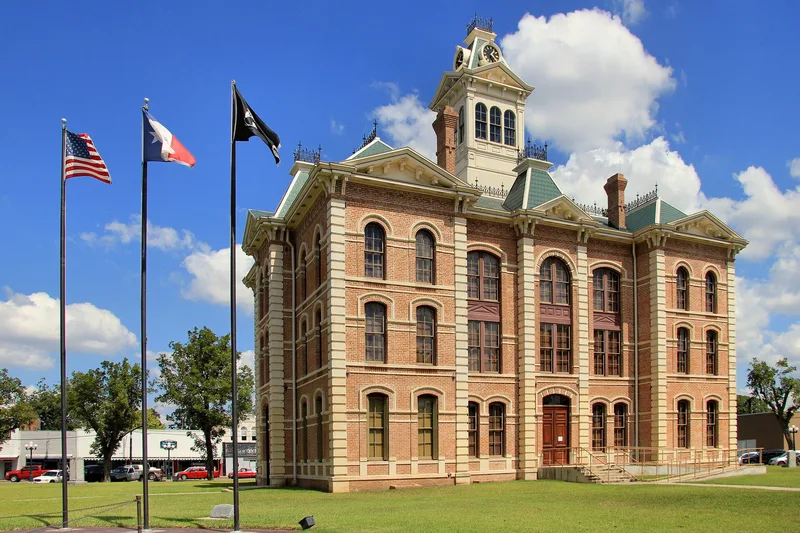
Wharton's historic downtown is a roughly 21-acre district of one- to three-story brick buildings clustered around the Wharton County Courthouse square and stretching west along Milam Street. Most of its 48 contributing buildings date from 1889 to 1935. Late-Victorian commercial blocks with Romanesque and Italianate details and decorative brick parapets stand alongside simpler early-20th-century buildings, including the 1913 Harrison Building with its Prairie School influence. Depression-era public buildings, among them the 1938 county jail designed by Wyatt C. Hedrick, the 1931 municipal building and the remodeled 1934 courthouse, give the square a strong Art Deco character. The town was laid out in 1846 around a courthouse square and became a supply and shipping point for plantations and later farms along the Colorado River. Railroad service in the 1880s brought brick construction. Although many storefronts have been altered, the upper facades largely survive, and the district remains a legible record of the town's commercial and governmental core.
Machine-generated summary. This summary was generated by a language model from the official nomination document and has not been reviewed line by line by an editor. It may contain errors. Check the source document before relying on any detail. Source: nomination document (PDF) · catalog entry. Generated October 2026 (model claude-sonnet-5-5, prompt v1.0-2026-10-29).
| Period of significance | 1889-1941 |
|---|---|
| Styles | Late 19th and Early 20th Century American Movements; Moderne (Art Deco) |
| Areas of significance | Commerce, Politics/Government, Architecture |
| Acreage | 21 |
| Boundary source | NPS cultural-resource GIS polygon |
| Full listing page | Wharton County Courthouse Historic Commercial District (property record) |
What listing means for this property
This is a historic district. Buildings within its boundary are either contributing (they add to the district's significance) or non-contributing. Owners of contributing income-producing buildings can claim the 20% federal rehabilitation tax credit; homeowners should look at state credits. National Register districts impose no design review by themselves; a local historic district ordinance, if one exists, does (the difference explained).
General information, not legal or tax advice. Rules change; confirm with your State Historic Preservation Office or a qualified adviser.