Weatherford Downtown Historic District

Why it's listed
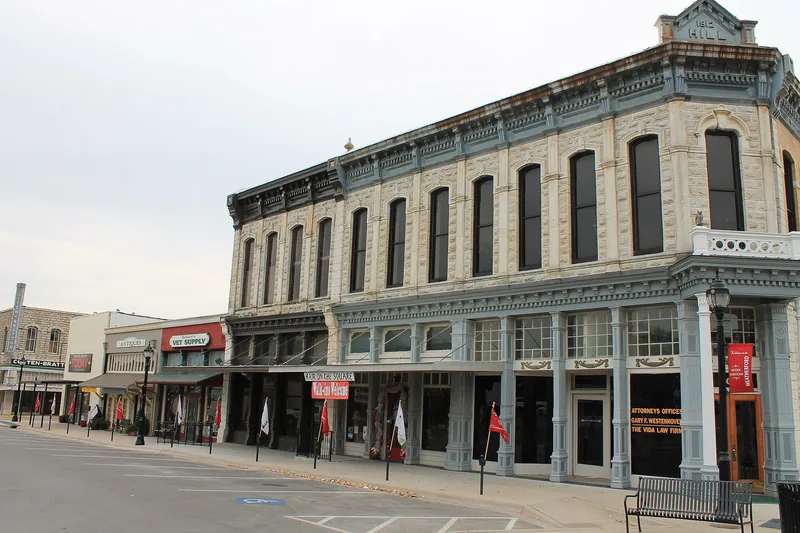
Weatherford's downtown is organized around the Parker County Courthouse, a Second Empire building from 1886 that sits in a large traffic circle where four major routes meet. Around it, the district holds late 19th century two-story limestone and brick commercial buildings with Italianate detailing, simpler early 20th century brick storefronts, small warehouses near the railroad, and a cluster of Romanesque and Gothic Revival churches south of the square. Public buildings include a 1914 Classical Revival post office, a 1933 Moderne city hall and a Depression-era public market. The area matters because the Texas and Pacific Railroad, which arrived in 1880, turned a long-lived frontier outpost into a regional center for ranching and agricultural commerce, and the surviving buildings reflect that affluence. Highway routes, including the Bankhead Highway, shaped later growth. Of the roughly 126 buildings, 81 contribute to the historic character, covering the period 1874 to 1945.
Machine-generated summary. This summary was generated by a language model from the official nomination document and has not been reviewed line by line by an editor. It may contain errors. Check the source document before relying on any detail. Source: nomination document (PDF) · catalog entry. Generated October 2026 (model claude-sonnet-5-5, prompt v1.0-2026-10-29).
| Period of significance | 1874-1945 |
|---|---|
| Styles | Italianate; Commercial style |
| Areas of significance | Industry, Commerce, Politics/Government, Architecture, Religion |
| Acreage | 31 |
| Boundary source | NPS cultural-resource GIS polygon |
| Full listing page | Weatherford Downtown Historic District (property record) |
What listing means for this property
This is a historic district. Buildings within its boundary are either contributing (they add to the district's significance) or non-contributing. Owners of contributing income-producing buildings can claim the 20% federal rehabilitation tax credit; homeowners should look at state credits. National Register districts impose no design review by themselves; a local historic district ordinance, if one exists, does (the difference explained).
General information, not legal or tax advice. Rules change; confirm with your State Historic Preservation Office or a qualified adviser.