Triangle Motel

The National Park Service has not published a boundary polygon for this district; the map shows the listed properties inside it and the district's reference point.
Why it's listed
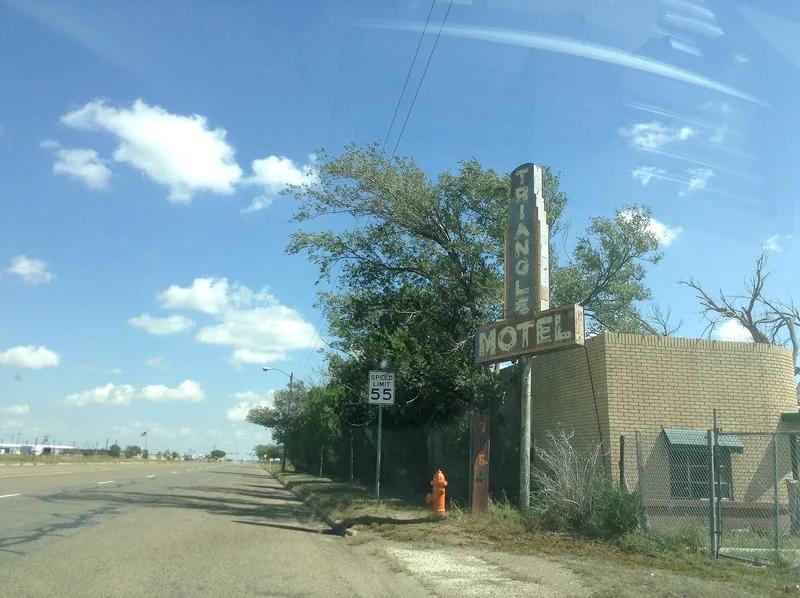
Where US 66 and US 60 meet in northeastern Amarillo, a triangular lot holds a roadside complex built to serve travelers with lodging, food and fuel. Six buildings went up between 1946 and 1952: two facing one-story motel wings in simplified Streamline Moderne, a café, a gas station, a house and a maintenance garage. The house was an assembly-line product delivered by truck, an early relative of the manufactured home. In 1956 the exteriors were covered with brick or Permastone veneer, and little has changed since. The motel rooms keep plaster walls, steel casement windows, redwood doors and tiled bathrooms, and a pole-mounted neon sign remains. The café and gas station are counted as noncontributing because of later alterations, including a roof added to the café in 2009. The complex is recognized for its link to Route 66 and Amarillo's tourist trade in the mid-twentieth century, and as a representative local example of the motel, café and gas station grouping. Silas "Si" Clayton is named as builder.
Machine-generated summary. This summary was generated by a language model from the official nomination document and has not been reviewed line by line by an editor. It may contain errors. Check the source document before relying on any detail. Source: nomination document (PDF) · catalog entry. Generated October 2026 (model claude-sonnet-5-5, prompt v1.0-2026-10-29).
| Period of significance | 1946-1960 |
|---|---|
| Styles | Modern Movement: Streamline Moderne; Commercial Vernacular; Minimal Traditional |
| Areas of significance | Architecture, Commerce, Transportation |
| Acreage | 5 |
| Boundary source | not published |
| Full listing page | Triangle Motel (property record) |
What listing means for this property
This is a historic district. Buildings within its boundary are either contributing (they add to the district's significance) or non-contributing. Owners of contributing income-producing buildings can claim the 20% federal rehabilitation tax credit; homeowners should look at state credits. National Register districts impose no design review by themselves; a local historic district ordinance, if one exists, does (the difference explained).
General information, not legal or tax advice. Rules change; confirm with your State Historic Preservation Office or a qualified adviser.