Thurber Historic District

Why it's listed
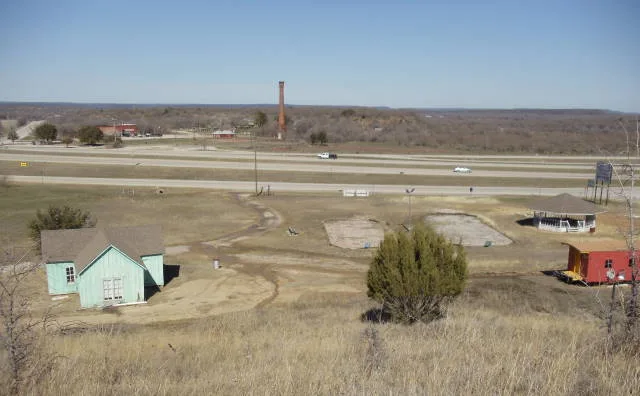
Thurber, in northwestern Erath County, Texas, was a coal mining and brick-making town owned entirely by the Texas Pacific Coal Company. Founded in the late 1880s, it grew to about 10,000 residents by 1921, then shrank to a handful after railroads switched to oil and highways to asphalt. The district protects what remains: a 150-foot brick smokestack dated 1906, the old drug store, dry goods building, fire house, water filtration plant, three early houses including that of manager W.K. Gordon, a cemetery with over 3,000 graves, two man-made lakes, brick plant ruins and mine sites. Foundations of hundreds of company houses reveal the town's planned layout. Thurber is noted as the first all-union town in the nation, an early adopter of electricity and sewer systems, and a community drawing workers of at least 18 nationalities. Its remains are valued especially for archaeological and historical study.
Machine-generated summary. This summary was generated by a language model from the official nomination document and has not been reviewed line by line by an editor. It may contain errors. Check the source document before relying on any detail. Source: nomination document (PDF) · catalog entry. Generated October 2026 (model claude-sonnet-5-5, prompt v1.0-2026-10-29).
| Period of significance | 1886 to 1936 |
|---|---|
| Areas of significance | Industry, Community Planning and Development, Commerce, Historic - Non-Aboriginal, Conservation, Engineering, Transportation, Social History |
| Acreage | 1006 |
| Boundary source | NPS cultural-resource GIS polygon |
| Full listing page | Thurber Historic District (property record) |
What listing means for this property
This is a historic district. Buildings within its boundary are either contributing (they add to the district's significance) or non-contributing. Owners of contributing income-producing buildings can claim the 20% federal rehabilitation tax credit; homeowners should look at state credits. National Register districts impose no design review by themselves; a local historic district ordinance, if one exists, does (the difference explained).
General information, not legal or tax advice. Rules change; confirm with your State Historic Preservation Office or a qualified adviser.