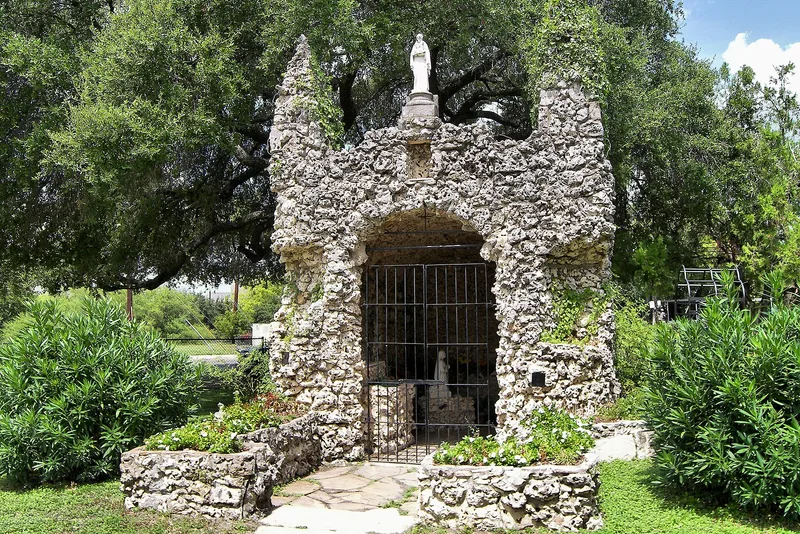
Stations of the Cross and Grotto at the Shrine of St. Anthony de Padua

The National Park Service has not published a boundary polygon for this district; the map shows the listed properties inside it and the district's reference point.
Why it's listed
Fourteen tall honeycomb limestone Stations of the Cross and a grotto stand along Peter Baque Road in San Antonio, on the grounds of the Shrine of St. Anthony de Padua. Sculptor Dionicio Rodriguez built the grotto in 1933 and the stations in 1936, under the supervision of Reverend Peter Baque. Each station is 13 to 16 feet tall, topped with pinnacles and a cement Celtic cross, and holds a marble relief of a scene from the Way of the Cross, with a donor's name below. The grotto is lined inside with seashells and holds statues of St. Anthony and the Virgin Mary. The parish was founded in 1925 to serve families of Cementville, a settlement of Alamo Portland Cement Company employees. The property was listed for its artistic value as Rodriguez's work, and it is one of only two Stations of the Cross he built. A relocated chapel on the site does not contribute to its significance.
Machine-generated summary. This summary was generated by a language model from the official nomination document and has not been reviewed line by line by an editor. It may contain errors. Check the source document before relying on any detail. Source: nomination document (PDF) · catalog entry. Generated October 2026 (model claude-sonnet-5-5, prompt v1.0-2026-10-29).
| Period of significance | 1933-1936 |
|---|---|
| Styles | Other: Rock sculpture |
| Areas of significance | Art |
| Acreage | 0.9 |
| Boundary source | not published |
| Full listing page | Stations of the Cross and Grotto at the Shrine of St. Anthony de Padua (property record) |
What listing means for this property
This is a historic district. Buildings within its boundary are either contributing (they add to the district's significance) or non-contributing. Owners of contributing income-producing buildings can claim the 20% federal rehabilitation tax credit; homeowners should look at state credits. National Register districts impose no design review by themselves; a local historic district ordinance, if one exists, does (the difference explained).
General information, not legal or tax advice. Rules change; confirm with your State Historic Preservation Office or a qualified adviser.