South Alamo Street-South Mary's Street Historic District

Why it's listed
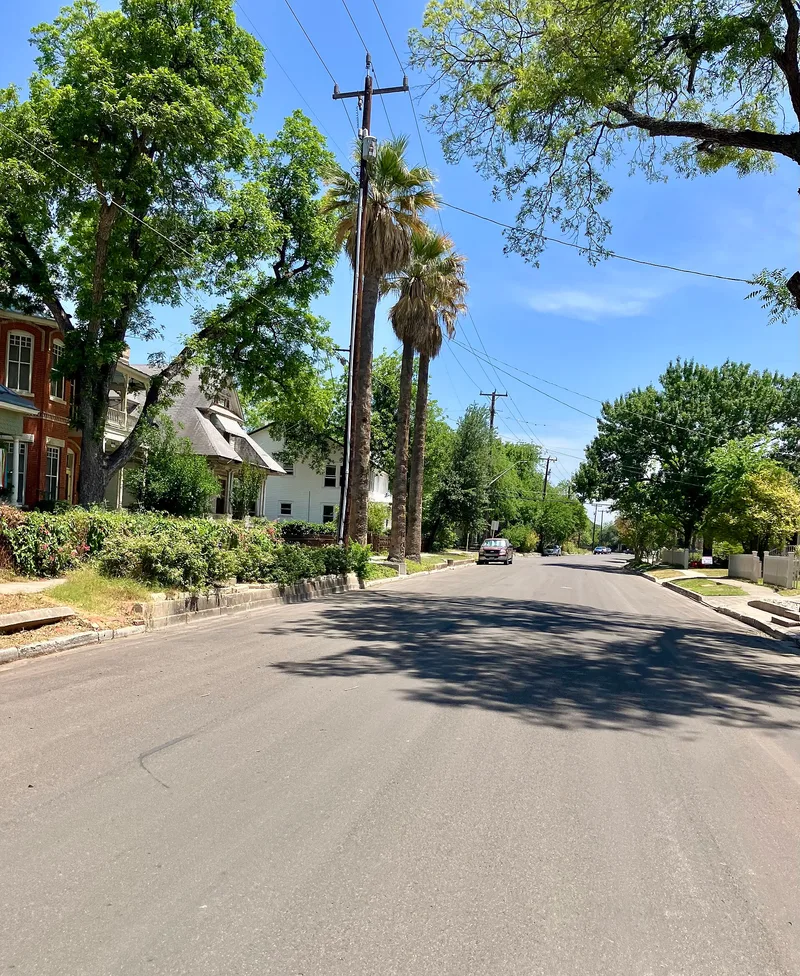
South of San Antonio's commercial center, between South Alamo and South St. Mary's streets and the San Antonio River, lies a residential district of 474 structures on roughly 125 acres. Its shape was set by old irrigation ditches and the river. Developers including Ernst Wehrhahn, the partnership of Hardin B. Adams and E. D. L. Wickes, and the Meerscheidt family laid out lots, and some sold completed houses. Most buildings are vernacular frame dwellings with decorative details, but the district also holds brick ell-plan houses, homes with jigsawn trim and Palladian openings, neoclassical houses, and blocks of bungalows. Houses along Crofton Avenue and East Guenther Street are the largest and most elaborate. Little was built after 1930, so the late nineteenth- and early twentieth-century fabric remains largely intact. Of the 474 structures, 332 contribute to the district's character. Commercial buildings are mostly confined to South Alamo and South St. Mary's streets, and a neighborhood association and a local historic district have supported preservation.
Machine-generated summary. This summary was generated by a language model from the official nomination document and has not been reviewed line by line by an editor. It may contain errors. Check the source document before relying on any detail. Source: nomination document (PDF) · catalog entry. Generated October 2026 (model claude-sonnet-5-5, prompt v1.0-2026-10-29).
| Styles | Vernacular frame dwellings, ell-plan houses, neoclassical, and bungalows, with late nineteenth- and early twentieth-century eclecticism |
|---|---|
| Areas of significance | Commerce, Architecture |
| Acreage | 175 |
| Boundary source | NPS cultural-resource GIS polygon |
| Full listing page | South Alamo Street-South Mary's Street Historic District (property record) |
What listing means for this property
This is a historic district. Buildings within its boundary are either contributing (they add to the district's significance) or non-contributing. Owners of contributing income-producing buildings can claim the 20% federal rehabilitation tax credit; homeowners should look at state credits. National Register districts impose no design review by themselves; a local historic district ordinance, if one exists, does (the difference explained).
General information, not legal or tax advice. Rules change; confirm with your State Historic Preservation Office or a qualified adviser.