Santa Rita Courts

Why it's listed
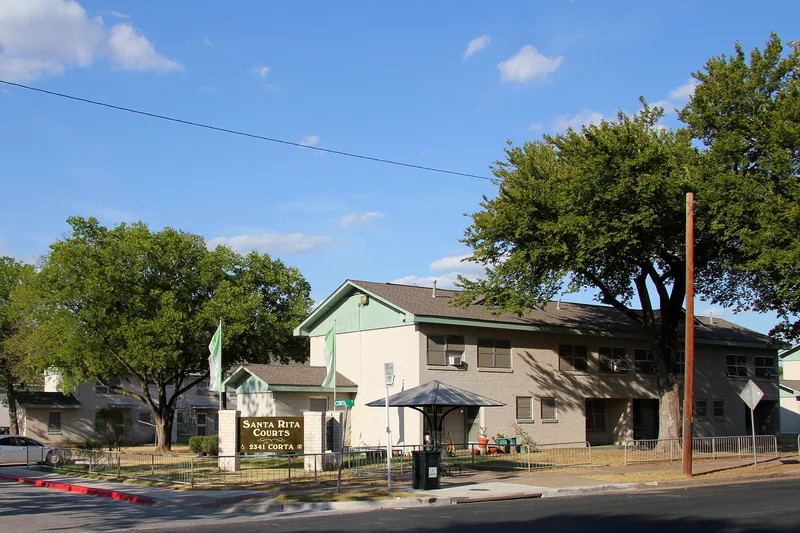
Santa Rita Courts is a public housing complex in east Austin, Texas, made up of 11 one-story residential buildings and a storage building on about 3.2 acres. Built between November 1938 and June 1939, it was designed by Giesecke & Harris under the supervision of H.F. Kuehne. The buildings follow International Style principles, with parallel rows laid out for light and a central children's play area based on German Zeilenbau planning. It was built for families of Mexican descent, as one of three segregated East Austin projects. The nomination identifies it as the first public housing project completed under the 1937 Housing Act. It also stresses the role of Congressman Lyndon Baines Johnson, who pushed for Austin to be first and who posed with the first family to move in. The project cost far less per unit than the national average. The buildings keep their original site plan, and the complex still serves as public housing today. A later 1954 annex lies outside the listed area.
Machine-generated summary. This summary was generated by a language model from the official nomination document and has not been reviewed line by line by an editor. It may contain errors. Check the source document before relying on any detail. Source: nomination document (PDF) · catalog entry. Generated October 2026 (model claude-sonnet-5-5, prompt v1.0-2026-10-29).
| Period of significance | 1938-1957 |
|---|---|
| Styles | Modern Movement: International Style |
| Areas of significance | Social History, Politics/Government, Community Planning and Development |
| Acreage | 3.2 |
| Boundary source | NPS cultural-resource GIS polygon |
| Full listing page | Santa Rita Courts (property record) |
What listing means for this property
This is a historic district. Buildings within its boundary are either contributing (they add to the district's significance) or non-contributing. Owners of contributing income-producing buildings can claim the 20% federal rehabilitation tax credit; homeowners should look at state credits. National Register districts impose no design review by themselves; a local historic district ordinance, if one exists, does (the difference explained).
General information, not legal or tax advice. Rules change; confirm with your State Historic Preservation Office or a qualified adviser.