San Antonio Missions National Historical Park

The National Park Service has not published a boundary polygon for this district; the map shows the listed properties inside it and the district's reference point.
Why it's listed
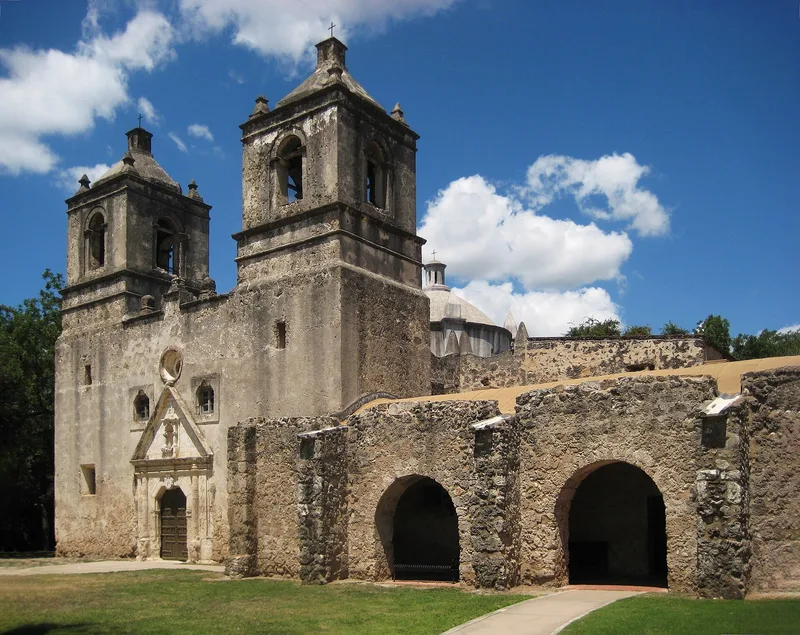
Four Spanish colonial missions strung along about eight miles of the San Antonio River make up this 475-acre district in south central San Antonio. From north to south they are Concepción, San José, San Juan Capistrano and Espada. Also included are the Espada and San Juan dams and acequias, the aqueduct carrying the Espada ditch over Piedras Creek, the mission fields, and prehistoric, colonial, Mexican and Anglo-American sites linked to the missions. In all, 86 structures and 21 archeological and historical sites record more than 260 years of history. Each mission followed a medieval European plan of enclosing wall, church, friary and Indian quarters. Much of the eighteenth-century character of the buildings remains, though painted decoration has mostly vanished and the compounds have changed. San José, reconstructed in the 1930s, best shows the original compound. Only the Espada acequia still carries water, and urban growth presses on the setting.
Machine-generated summary. This summary was generated by a language model from the official nomination document and has not been reviewed line by line by an editor. It may contain errors. Check the source document before relying on any detail. Source: nomination document (PDF) · catalog entry. Generated October 2026 (model claude-sonnet-5-5, prompt v1.0-2026-10-29).
| Styles | Spanish colonial mission architecture |
|---|---|
| Areas of significance | Religion, Engineering, Architecture, Commerce, Military, Agriculture |
| Acreage | 477.4 |
| Boundary source | not published |
| Full listing page | San Antonio Missions National Historical Park (property record) |
What listing means for this property
This is a historic district. Buildings within its boundary are either contributing (they add to the district's significance) or non-contributing. Owners of contributing income-producing buildings can claim the 20% federal rehabilitation tax credit; homeowners should look at state credits. National Register districts impose no design review by themselves; a local historic district ordinance, if one exists, does (the difference explained).
General information, not legal or tax advice. Rules change; confirm with your State Historic Preservation Office or a qualified adviser.