Laguna Gloria

Why it's listed
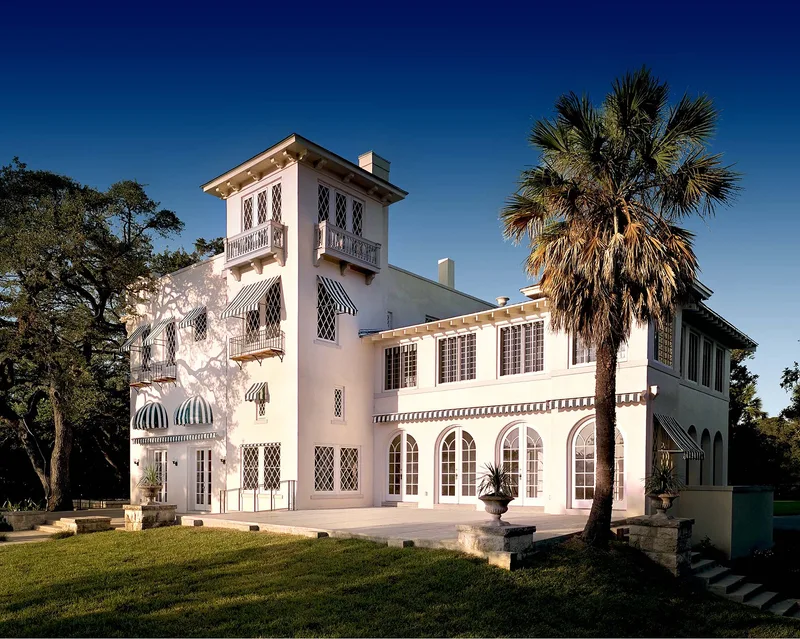
Laguna Gloria is a 1916 Mediterranean-style villa set on a high bluff above the Colorado River in Austin, Texas. Architect Harvey L. Page of San Antonio designed it and Jack Johnson built it of stuccoed masonry and concrete. A four-story tower dominates the asymmetrical blocks, and a carved limestone window modeled on the rose window of San Jose Mission lights the main stairway. Italian-style gardens with statuary, terraces and a fountain surround the house, and a lagoon wraps the peninsula to the south and east. The villa was the winter home of Clara Driscoll and Henry Hulme Sevier from 1916 to 1929. Driscoll became known as the Savior of the Alamo after buying the property to prevent its destruction, and Sevier served as a legislator, newspaper publisher and ambassador to Chile. The land had earlier been chosen by Stephen F. Austin as a future home site. In 1943 Driscoll gave the property to a state art association on condition that it be kept as an art museum, which is how it is still used.
Machine-generated summary. This summary was generated by a language model from the official nomination document and has not been reviewed line by line by an editor. It may contain errors. Check the source document before relying on any detail. Source: nomination document (PDF) · catalog entry. Generated October 2026 (model claude-sonnet-5-5, prompt v1.0-2026-10-29).
| Styles | Mediterranean style villa |
|---|---|
| Areas of significance | Landscape Architecture, Politics/Government, Architecture, Communications |
| Acreage | 18 |
| Boundary source | NPS cultural-resource GIS polygon |
| Full listing page | Laguna Gloria (property record) |
What listing means for this property
This is a historic district. Buildings within its boundary are either contributing (they add to the district's significance) or non-contributing. Owners of contributing income-producing buildings can claim the 20% federal rehabilitation tax credit; homeowners should look at state credits. National Register districts impose no design review by themselves; a local historic district ordinance, if one exists, does (the difference explained).
General information, not legal or tax advice. Rules change; confirm with your State Historic Preservation Office or a qualified adviser.