Eddingston Court

Why it's listed
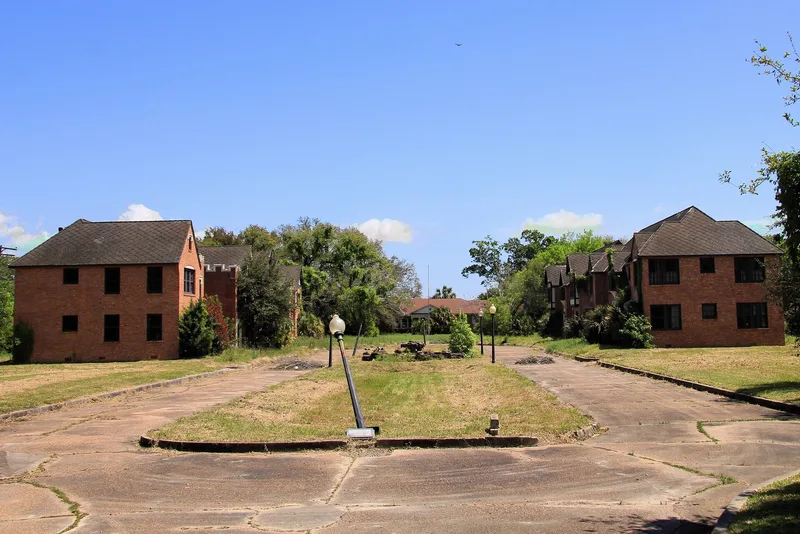
Eddingston Court is an apartment complex on Proctor Street in Port Arthur, Texas, beside the Sabine-Neches Ship Channel. Tugboat captain Ambrose T. Eddingston built it around 1929 to meet the housing needs of a fast-growing oil-refining city. Two pairs of two-story Tudor-style brick buildings face each other across a central garden, with wood-frame garages behind. Eddingston hired sculptor Dionicio Rodriguez and a group of San Antonio artisans to decorate the grounds. They produced a 98-foot conch shell wall, a shell-covered Sound Cave, rock fountains, a fishpond, log-style seats, a table and a cement basket. The shells were brought from Grand Cayman, Eddingston's birthplace. The complex is considered significant as a major Rodriguez work and as an intact early residential development, said to be the first of its type in Port Arthur. Today the pond is dry, the garden is overgrown, and the property is listed as vacant.
Machine-generated summary. This summary was generated by a language model from the official nomination document and has not been reviewed line by line by an editor. It may contain errors. Check the source document before relying on any detail. Source: nomination document (PDF) · catalog entry. Generated October 2026 (model claude-sonnet-5-5, prompt v1.0-2026-10-29).
| Period of significance | 1929 |
|---|---|
| Styles | Late 19th and 20th Century Revivals: Tudor, Classical Revival; faux bois sculpture |
| Areas of significance | Art, Landscape Architecture, Community Planning and Development |
| Boundary source | NPS cultural-resource GIS polygon |
| Full listing page | Eddingston Court (property record) |
What listing means for this property
This is a historic district. Buildings within its boundary are either contributing (they add to the district's significance) or non-contributing. Owners of contributing income-producing buildings can claim the 20% federal rehabilitation tax credit; homeowners should look at state credits. National Register districts impose no design review by themselves; a local historic district ordinance, if one exists, does (the difference explained).
Noted as vacant in the nomination. Nomination documents can be decades old; current status may differ. If you are considering buying an empty listed property, read the due-diligence checklist.
General information, not legal or tax advice. Rules change; confirm with your State Historic Preservation Office or a qualified adviser.