Delwood Duplex Historic District

Why it's listed
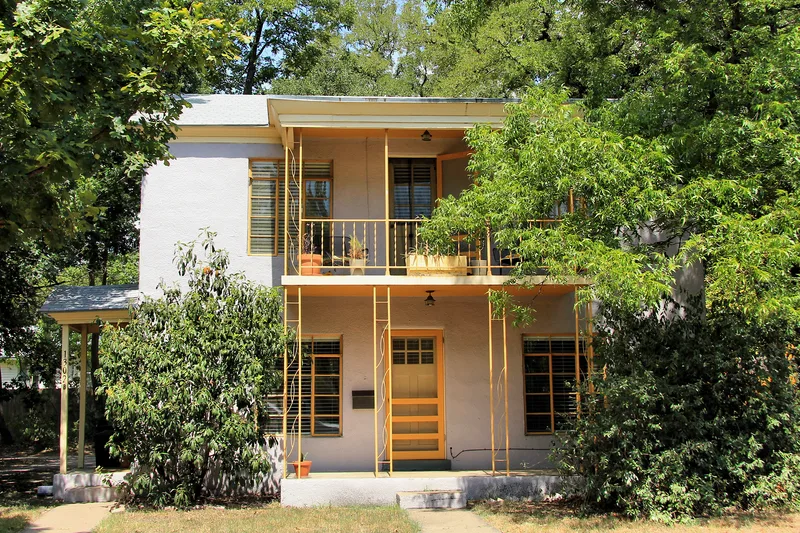
Northeast of downtown Austin, this neighborhood of 77 two-story duplexes was built in 1948 as the Delwood III development. Each stucco-covered concrete block building holds two apartments, one per floor, of about 900 square feet with two bedrooms and one bathroom. Most have a freestanding concrete block garage behind, reached by an alley. The buildings share a boxy form but vary in roof shape and porch arrangement, giving them the look of minimal Colonial Revival houses. Original steel casement windows survive on most. Developer Bascom Giles, through Delwood Apartments, Inc., was responsible for construction. The area was listed because it shows how postwar housing for moderate-income families was produced through tract development, and it is the only concentration of duplex tract housing in Austin. Nearly all the buildings still serve as homes, with few major alterations, no teardowns and no vacant lots, so the district keeps a high level of integrity. Of 150 resources, 136 are counted as contributing.
Machine-generated summary. This summary was generated by a language model from the official nomination document and has not been reviewed line by line by an editor. It may contain errors. Check the source document before relying on any detail. Source: nomination document (PDF) · catalog entry. Generated October 2026 (model claude-sonnet-5-5, prompt v1.0-2026-10-29).
| Period of significance | 1948 |
|---|---|
| Styles | Stripped Colonial (minimal references to Colonial/Classical Revival) |
| Areas of significance | Community Planning and Development |
| Acreage | 20 |
| Boundary source | NPS cultural-resource GIS polygon |
| Full listing page | Delwood Duplex Historic District (property record) |
What listing means for this property
This is a historic district. Buildings within its boundary are either contributing (they add to the district's significance) or non-contributing. Owners of contributing income-producing buildings can claim the 20% federal rehabilitation tax credit; homeowners should look at state credits. National Register districts impose no design review by themselves; a local historic district ordinance, if one exists, does (the difference explained).
General information, not legal or tax advice. Rules change; confirm with your State Historic Preservation Office or a qualified adviser.