Cottle County Courthouse Historic District

Why it's listed
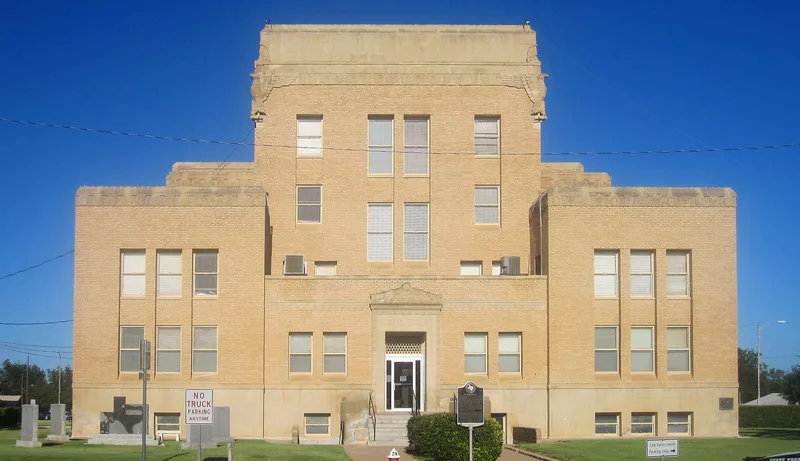
Paducah's courthouse square in Cottle County, Texas, forms a historic district of 47 contributing and 20 noncontributing resources. At its center is the four-story Art Deco courthouse, designed by the Wichita Falls firm Voelcker and Dixon and built in 1929-30 to replace an 1894 Italianate courthouse. Around it, mostly brick one-part and two-part commercial buildings line the streets, along with a hotel, a theater and a VFW hall. Most date from two building periods, 1908-1910 and 1928-1930, and many show decorative brickwork in their parapets. The district reflects Paducah's growth as a farming and mercantile center after the county seat was established in 1892, the railroad arrived in 1909 and the town incorporated in 1910. Banks, stores and later the Palace Theatre and Cottle Hotel illustrate that prosperity. Because the area's later economic decline limited rebuilding, many storefronts retain original features, so the square still reads as a typical Texas courthouse square. It was recognized for commerce, community development and architecture.
Machine-generated summary. This summary was generated by a language model from the official nomination document and has not been reviewed line by line by an editor. It may contain errors. Check the source document before relying on any detail. Source: nomination document (PDF) · catalog entry. Generated October 2026 (model claude-sonnet-5-5, prompt v1.0-2026-10-29).
| Styles | Mediterranean Revival, Spanish Revival, Commercial Style, Art Deco |
|---|---|
| Areas of significance | Commerce, Community Planning and Development, Architecture |
| Acreage | 13.9 |
| Boundary source | NPS cultural-resource GIS polygon |
| Full listing page | Cottle County Courthouse Historic District (property record) |
What listing means for this property
This is a historic district. Buildings within its boundary are either contributing (they add to the district's significance) or non-contributing. Owners of contributing income-producing buildings can claim the 20% federal rehabilitation tax credit; homeowners should look at state credits. National Register districts impose no design review by themselves; a local historic district ordinance, if one exists, does (the difference explained).
General information, not legal or tax advice. Rules change; confirm with your State Historic Preservation Office or a qualified adviser.