Colorado County Courthouse Historic District

Why it's listed
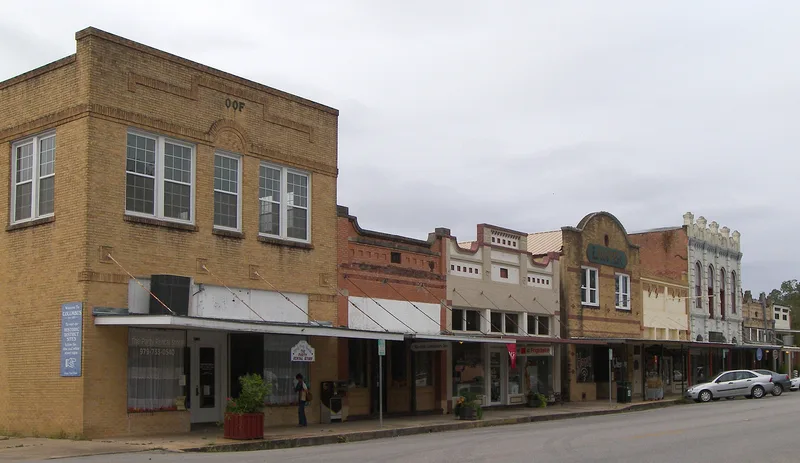
Columbus, Texas, grew around its courthouse square, and this district preserves that core. Twelve full blocks and parts of thirteen more make up an L-shaped area of shops, offices and homes. Commercial buildings cluster along Milam Street, where the 1100 block keeps much of its original character. The Stafford Opera House of 1886, designed by Galveston architect Nicholas J. Clayton in Richardsonian Romanesque style, is the most commanding structure. Nearby stand the courthouse and an 1883 circular brick water tower and fire house, now used as a meeting hall. Most houses are modest one-story wood-frame buildings with Victorian decoration, alongside Greek Revival examples and twentieth-century bungalows. Some modern intrusions, such as mobile homes and 1960s commercial buildings, are a minority. The district was recognized as a record of the town's prosperity in the later nineteenth century. Local preservation work, including restoration of the opera house, has been under way since the 1960s.
Machine-generated summary. This summary was generated by a language model from the official nomination document and has not been reviewed line by line by an editor. It may contain errors. Check the source document before relying on any detail. Source: nomination document (PDF) · catalog entry. Generated October 2026 (model claude-sonnet-5-5, prompt v1.0-2026-10-29).
| Styles | Mixed nineteenth-century styles: Greek Revival, Victorian, Richardsonian Romanesque, Colonial Revival and vernacular, plus twentieth-century bungalows |
|---|---|
| Areas of significance | Exploration/Settlement, Architecture |
| Acreage | 11.5 |
| Boundary source | NPS cultural-resource GIS polygon |
| Full listing page | Colorado County Courthouse Historic District (property record) |
What listing means for this property
This is a historic district. Buildings within its boundary are either contributing (they add to the district's significance) or non-contributing. Owners of contributing income-producing buildings can claim the 20% federal rehabilitation tax credit; homeowners should look at state credits. National Register districts impose no design review by themselves; a local historic district ordinance, if one exists, does (the difference explained).
General information, not legal or tax advice. Rules change; confirm with your State Historic Preservation Office or a qualified adviser.