City Water Works

The National Park Service has not published a boundary polygon for this district; the map shows the listed properties inside it and the district's reference point.
Why it's listed
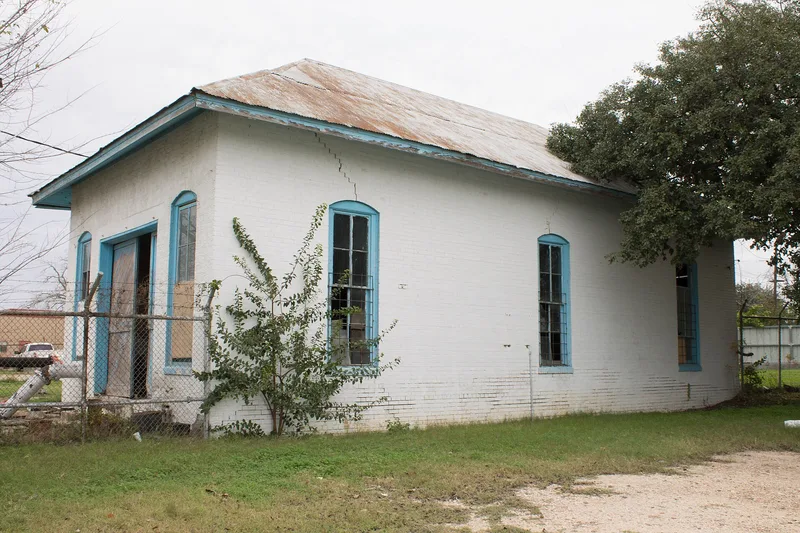
Cuero's City Water Works is a small utility complex at 208 S. Esplanade, just south of the downtown commercial core. Established around 1910, it includes two pumphouses and a concrete-lined reservoir on a lot of less than an acre. The easternmost pumphouse, facing Esplanade Street, is brick with a stucco finish, segmental-arched openings, wood double-hung windows, a hip roof with composition shingles, and a small gable with jig-sawn bargeboard. The second pumphouse is similarly detailed but has a corrugated-metal roof. By 1930 another pumphouse had been built on the south side of the lot. A machine shop built after 1935 and a modern water tower are noted as noncontributing. The complex was recognized for its Romanesque Revival-influenced architecture, its few alterations, and its integrity. It has supplied water for over seven decades, which the nomination credits to the engineering of its original designers and builders. The architect and builder are unknown.
Machine-generated summary. This summary was generated by a language model from the official nomination document and has not been reviewed line by line by an editor. It may contain errors. Check the source document before relying on any detail. Source: nomination document (PDF) · catalog entry. Generated October 2026 (model claude-sonnet-5-5, prompt v1.0-2026-10-29).
| Styles | Romanesque Revival-influenced |
|---|---|
| Areas of significance | Architecture |
| Acreage | 0.9 |
| Boundary source | not published |
| Full listing page | City Water Works (property record) |
What listing means for this property
This is a historic district. Buildings within its boundary are either contributing (they add to the district's significance) or non-contributing. Owners of contributing income-producing buildings can claim the 20% federal rehabilitation tax credit; homeowners should look at state credits. National Register districts impose no design review by themselves; a local historic district ordinance, if one exists, does (the difference explained).
General information, not legal or tax advice. Rules change; confirm with your State Historic Preservation Office or a qualified adviser.