Thunderbird Lodge

The National Park Service has not published a boundary polygon for this district; the map shows the listed properties inside it and the district's reference point.
Why it's listed
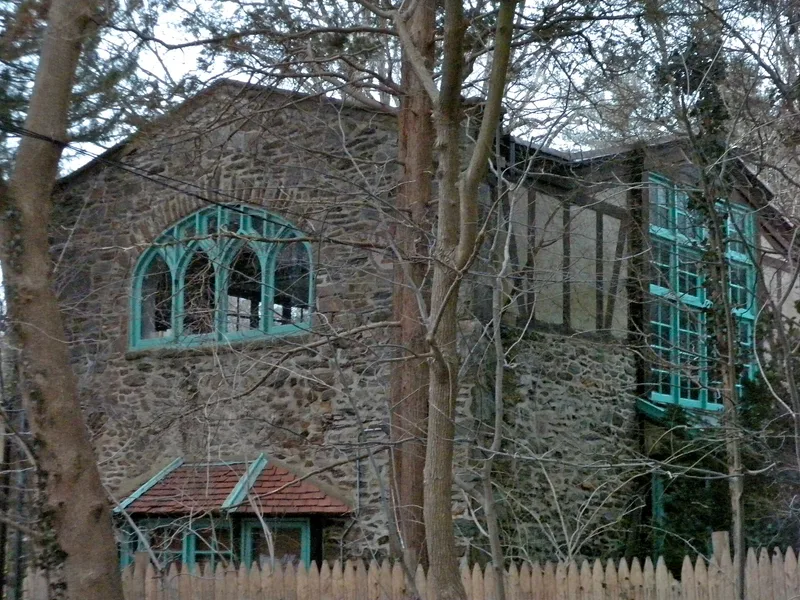
Built within a late eighteenth-century fieldstone banked barn, this artists' residence in Rose Valley, Delaware County, Pennsylvania, was remodeled in 1904 by architect William Lightfoot Price for the illustrators Alice Barber Stephens and Charles H. Stephens. The asymmetrical house combines quarried gneiss and flint, stucco over frame, and red Mercer ceramic tile, with two studios having large northern windows. A thunderbird motif in a fireplace and in tile gave the building its name. The property is regarded as a major early work of the Arts and Crafts movement in America and as Price's first large-scale new construction in the style he later promoted in his writings. The house also served from 1921 onward as the home of Allen Seymour and Mildred Scott Olmsted, who hosted informal meetings on racial equality, civil liberties, women's rights and peace. The grounds, with pergolas, a springhouse, a stable garage and a 1926 monument marking the Great Minquas Trail, are documented as retaining their original design.
Machine-generated summary. This summary was generated by a language model from the official nomination document and has not been reviewed line by line by an editor. It may contain errors. Check the source document before relying on any detail. Source: nomination document (PDF) · catalog entry. Generated October 2026 (model claude-haiku-5-5, prompt v1.1-2026-10-29).
| Period of significance | c.1790, 1904-1938 |
|---|---|
| Styles | Bungalow/Craftsman |
| Areas of significance | Art, Architecture, Social History |
| Acreage | 1.6 |
| Boundary source | not published |
| Full listing page | Thunderbird Lodge (property record) |
What listing means for this property
This is a historic district. Buildings within its boundary are either contributing (they add to the district's significance) or non-contributing. Owners of contributing income-producing buildings can claim the 20% federal rehabilitation tax credit; homeowners should look at state credits. National Register districts impose no design review by themselves; a local historic district ordinance, if one exists, does (the difference explained).
General information, not legal or tax advice. Rules change; confirm with your State Historic Preservation Office or a qualified adviser.