Summit Hotel

Why it's listed
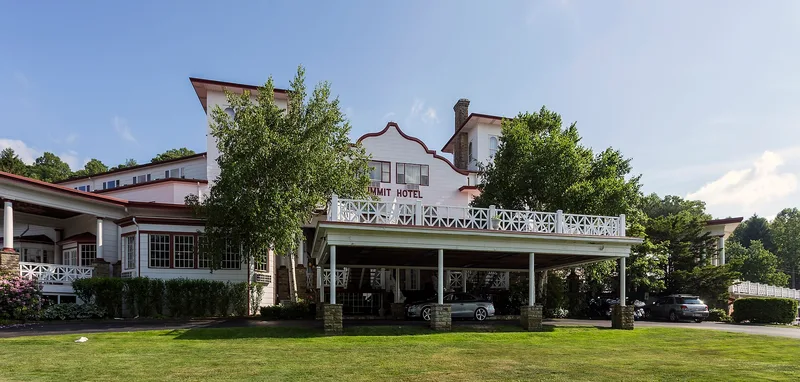
Built in 1907 on a terraced site near the summit of Chestnut Ridge, the Summit Hotel is a three-story Mission and Craftsman resort with a parapeted central gable, two flanking four-story square towers, and long hipped wings extending east and west. Its first floor and foundation are Pocono sandstone quarried on the site, and a porch 15 feet deep runs along the main facade. A wing added circa 1923 to the south matches the original detailing. Inside, the lobby has a 14-foot cut-stone fireplace and original grained cypress woodwork. The complex was designed to serve motor tourists travelling the National Road, and it kept its support buildings, including a carriage house, staff dormitory, stable and garage, cottages, a 1923 swimming pool with pool house and pavilion, and two steel water tanks. The nomination regards it as one of only two mountain resort hotels built along the National Road corridor in that period, the other being Gorley's Lake Hotel in Wharton Township.
Machine-generated summary. This summary was generated by a language model from the official nomination document and has not been reviewed line by line by an editor. It may contain errors. Check the source document before relying on any detail. Source: nomination document (PDF) · catalog entry. Generated October 2026 (model claude-haiku-5-5, prompt v1.1-2026-10-29).
| Period of significance | 1907-1954 |
|---|---|
| Styles | Craftsman/Mission |
| Areas of significance | Commerce, Entertainment/Recreation, Architecture |
| Acreage | 50 |
| Boundary source | NPS cultural-resource GIS polygon |
| Full listing page | Summit Hotel (property record) |
What listing means for this property
This is a historic district. Buildings within its boundary are either contributing (they add to the district's significance) or non-contributing. Owners of contributing income-producing buildings can claim the 20% federal rehabilitation tax credit; homeowners should look at state credits. National Register districts impose no design review by themselves; a local historic district ordinance, if one exists, does (the difference explained).
General information, not legal or tax advice. Rules change; confirm with your State Historic Preservation Office or a qualified adviser.