Strickland, William, Row

The National Park Service has not published a boundary polygon for this district; the map shows the listed properties inside it and the district's reference point.
Why it's listed
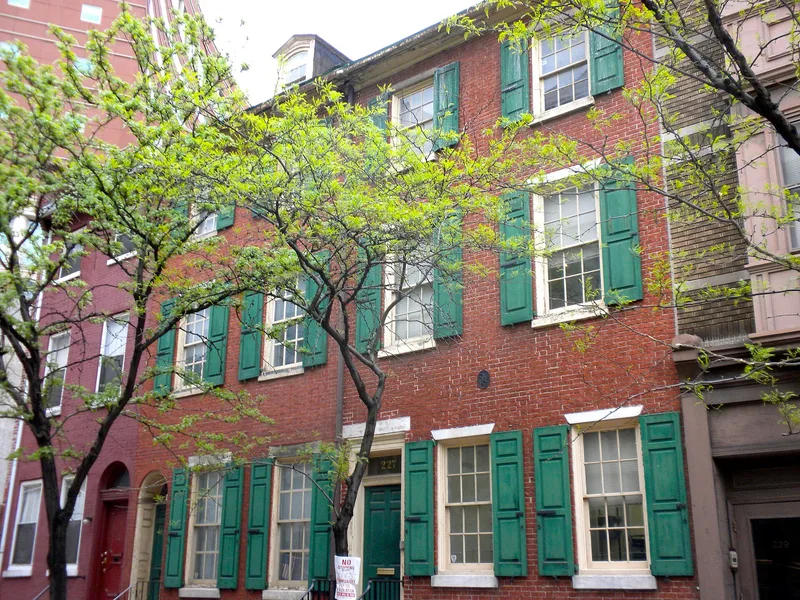
Built around 1815 on South Ninth Street in Philadelphia, this row of three-and-a-half-story brick houses from 215 to 227 was constructed for merchants and professionals. Benjamin Taylor, a bricklayer, sold each lot for five shillings and an annual ground rent to craftsmen in the building trades, who agreed to erect brick houses within two to four years. The first purchasers included iron mongers, carpenters, bricklayers, a blacksmith, a bootmaker and a plasterer, and the similarity of design suggests they pooled their skills to build the row. Each house had six to eight rooms, a rear piazza and a back building, with marble steps, molded cornices and six-over-six windows. The row is significant as a representative middle-class block of the years after the War of 1812. William Strickland, architect of the Second Bank of the United States and the U.S. Mint, owned and lived in 219 from 1823 to 1829. Changes to the first floors and window sash have altered the facades, but the rhythm of the row has survived.
Machine-generated summary. This summary was generated by a language model from the official nomination document and has not been reviewed line by line by an editor. It may contain errors. Check the source document before relying on any detail. Source: nomination document (PDF) · catalog entry. Generated October 2026 (model claude-haiku-5-5, prompt v1.1-2026-10-29).
| Period of significance | circa 1815 |
|---|---|
| Styles | Early Greek Revival |
| Areas of significance | Community Planning and Development, Architecture |
| Acreage | 0.9 |
| Boundary source | not published |
| Full listing page | Strickland, William, Row (property record) |
What listing means for this property
This is a historic district. Buildings within its boundary are either contributing (they add to the district's significance) or non-contributing. Owners of contributing income-producing buildings can claim the 20% federal rehabilitation tax credit; homeowners should look at state credits. National Register districts impose no design review by themselves; a local historic district ordinance, if one exists, does (the difference explained).
General information, not legal or tax advice. Rules change; confirm with your State Historic Preservation Office or a qualified adviser.