Phillips Mill Historic District

Why it's listed
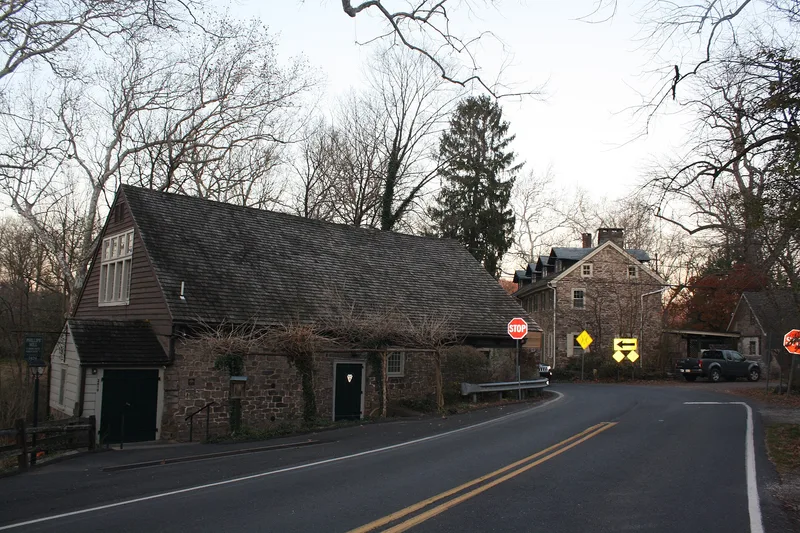
Phillips Mill is a grist mill complex on a bend of Primrose Creek in Solebury Township, Bucks County, with a village that developed around it. Aaron Phillips acquired the property in the 1750s, and the Phillips family operated the mill until 1889, when it was sold to Stephen Betts. The mill was a large building for its day, with an overshot wheel and three stones. In 1896 Dr. George M. Marshall bought the complex, and in 1903 the painter William Lathrop settled in the village. Lathrop's circle included Daniel Garber and Edward Redfield, and the area became an artists' colony. The architect Morgan Colt remodeled a former piggery into a Gothic/Tudor home with a walled garden. The Holmquist School for Girls, founded in 1917 on progressive principles, operated in the district until 1949, when it merged with the Solebury School. The St. Philips Chapel, a former one-room schoolhouse, is also within the district.
Machine-generated summary. This summary was generated by a language model from the official nomination document and has not been reviewed line by line by an editor. It may contain errors. Check the source document before relying on any detail. Source: nomination document (PDF) · catalog entry. Generated October 2026 (model claude-haiku-5-5, prompt v1.1-2026-10-29).
| Period of significance | 1700-1799 |
|---|---|
| Styles | Gothic/Tudor |
| Areas of significance | Industry, Commerce, Art, Agriculture, Education, Architecture |
| Acreage | 29 |
| Boundary source | NPS cultural-resource GIS polygon |
| Full listing page | Phillips Mill Historic District (property record) |
What listing means for this property
This is a historic district. Buildings within its boundary are either contributing (they add to the district's significance) or non-contributing. Owners of contributing income-producing buildings can claim the 20% federal rehabilitation tax credit; homeowners should look at state credits. National Register districts impose no design review by themselves; a local historic district ordinance, if one exists, does (the difference explained).
General information, not legal or tax advice. Rules change; confirm with your State Historic Preservation Office or a qualified adviser.