Parker's Ford

Why it's listed
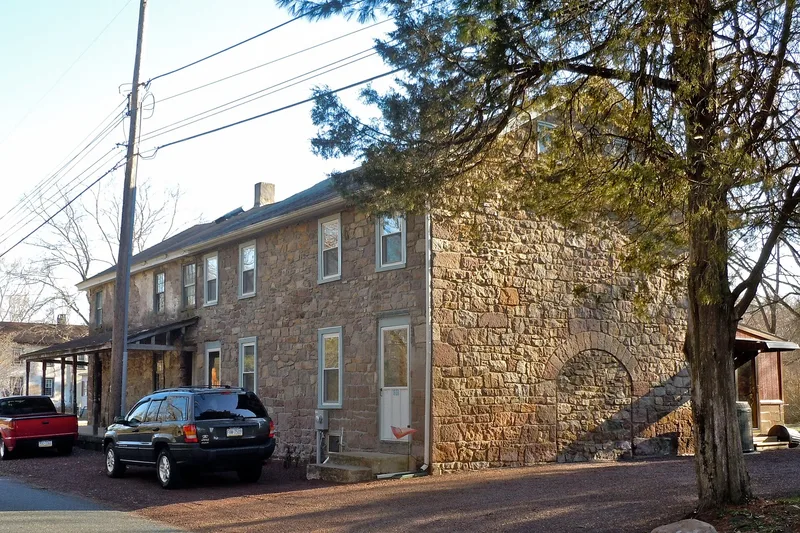
Along an early river trail on the Schuylkill's west bank in Chester County, a group of mid-eighteenth-century buildings forms the Parker's Ford complex. The tavern, dated 1766 and built by Edward Parker, is two stories of local red sandstone with a kitchen wing, a courtyard, and a two-level cellar with unusual log-and-rubble basement framing. Nearby stand a stable building, a house dated 1801 built by Henry Parker and his wife Susannah, and other early houses. The complex grew from a grist and saw mill recorded by 1720. Its significance rests on its role as a roadside inn on the Great Road from Philadelphia to Reading, and on its visit by George Washington's army, which crossed the river at the ford in September 1777 and used the tavern as temporary headquarters. Later, the Schuylkill River Canal and the Pennsylvania Railroad shaped its use and decline, and the complex is regarded as a rare surviving example of a colonial tavern complex connected to Pennsylvania transportation history.
Machine-generated summary. This summary was generated by a language model from the official nomination document and has not been reviewed line by line by an editor. It may contain errors. Check the source document before relying on any detail. Source: nomination document (PDF) · catalog entry. Generated October 2026 (model claude-haiku-5-5, prompt v1.1-2026-10-29).
| Areas of significance | Commerce, Transportation |
|---|---|
| Acreage | 7.5 |
| Boundary source | NPS cultural-resource GIS polygon |
| Full listing page | Parker's Ford (property record) |
What listing means for this property
This is a historic district. Buildings within its boundary are either contributing (they add to the district's significance) or non-contributing. Owners of contributing income-producing buildings can claim the 20% federal rehabilitation tax credit; homeowners should look at state credits. National Register districts impose no design review by themselves; a local historic district ordinance, if one exists, does (the difference explained).
General information, not legal or tax advice. Rules change; confirm with your State Historic Preservation Office or a qualified adviser.