Old Germantown Academy And Headmasters' Houses

The National Park Service has not published a boundary polygon for this district; the map shows the listed properties inside it and the district's reference point.
Why it's listed
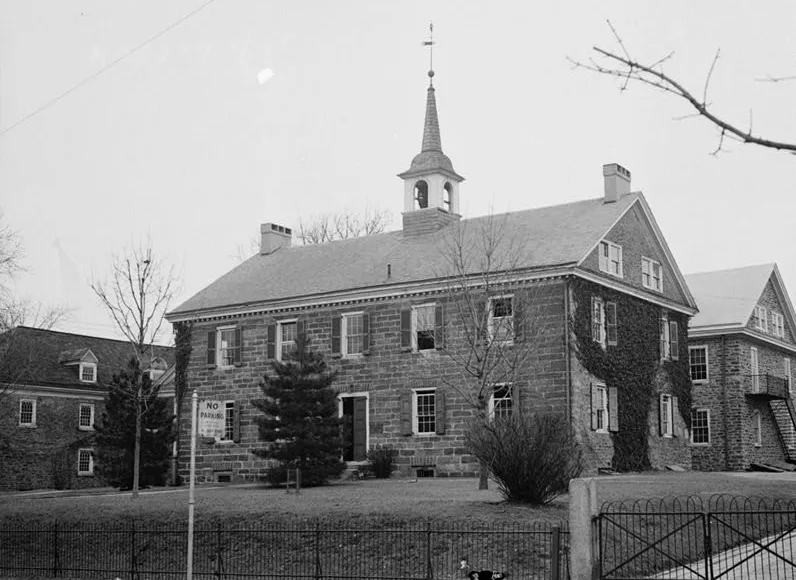
Germantown Academy began as the Germantown Union School House, founded in 1760 after a meeting in December 1759 at which local citizens agreed to build a nonsectarian school. The trustees received the land from John Bringhurst in 1760. The Main building is two and a half stories high with a rubble masonry body, a shingled roof, and a spire and belfry holding a bell cast in London in 1773 and brought to Germantown in 1784. Two small stone headmasters' houses stand beside it. The school's headmasters included David James Dove and A. Bronson Alcott, who assumed the post in 1831. During the Battle of Germantown in 1777 the building served as a hospital, and the school was closed from 1778 to 1784. The school is also noted as the oldest school in the United States functioning in its original buildings until 1960.
Machine-generated summary. This summary was generated by a language model from the official nomination document and has not been reviewed line by line by an editor. It may contain errors. Check the source document before relying on any detail. Source: nomination document (PDF) · catalog entry. Generated October 2026 (model claude-haiku-5-5, prompt v1.1-2026-10-29).
| Period of significance | 18th Century |
|---|---|
| Areas of significance | Education, Architecture |
| Acreage | 9.9 |
| Boundary source | not published |
| Full listing page | Old Germantown Academy And Headmasters' Houses (property record) |
What listing means for this property
This is a historic district. Buildings within its boundary are either contributing (they add to the district's significance) or non-contributing. Owners of contributing income-producing buildings can claim the 20% federal rehabilitation tax credit; homeowners should look at state credits. National Register districts impose no design review by themselves; a local historic district ordinance, if one exists, does (the difference explained).
General information, not legal or tax advice. Rules change; confirm with your State Historic Preservation Office or a qualified adviser.