Newtown Historic District

Why it's listed
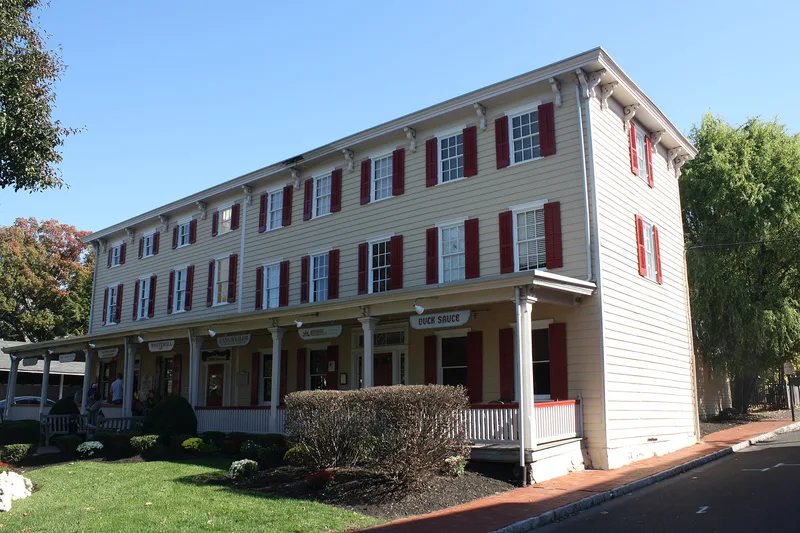
Newtown is a village whose historic district contains about 230 buildings and 82 barns or carriage sheds, mostly built between the late 17th and early 20th centuries. The district follows State Street and Washington Avenue and takes in the original Court House tract, where many 18th-century stone and brick town houses survive. Its significance rests on several strands of history. Thomas Holme laid out the townstead in 1683 and 1684 under William Penn's plan, and the county seat was at Newtown from 1725 until 1813. The village served as a Continental army supply depot and as headquarters for General Washington and his officers, and it held about 1,000 Hessian prisoners after the Battle of Trenton. Edward Hicks, the primitive painter, lived in Newtown from 1811 until his death in 1849, and two of his houses remain in the district. The architecture spans colonial to Victorian styles and is regarded as an unusually well-preserved group.
Machine-generated summary. This summary was generated by a language model from the official nomination document and has not been reviewed line by line by an editor. It may contain errors. Check the source document before relying on any detail. Source: nomination document (PDF) · catalog entry. Generated October 2026 (model claude-haiku-5-5, prompt v1.1-2026-10-29).
| Styles | Colonial, Federal, Georgian Revival, Greek Revival, Victorian, Italianate, Second Empire, Queen Anne |
|---|---|
| Areas of significance | Commerce, Agriculture, Military, Transportation, Politics/Government, Architecture |
| Acreage | 103.8 |
| Boundary source | NPS cultural-resource GIS polygon |
| Full listing page | Newtown Historic District (property record) |
What listing means for this property
This is a historic district. Buildings within its boundary are either contributing (they add to the district's significance) or non-contributing. Owners of contributing income-producing buildings can claim the 20% federal rehabilitation tax credit; homeowners should look at state credits. National Register districts impose no design review by themselves; a local historic district ordinance, if one exists, does (the difference explained).
General information, not legal or tax advice. Rules change; confirm with your State Historic Preservation Office or a qualified adviser.