Newport Historic District

Why it's listed
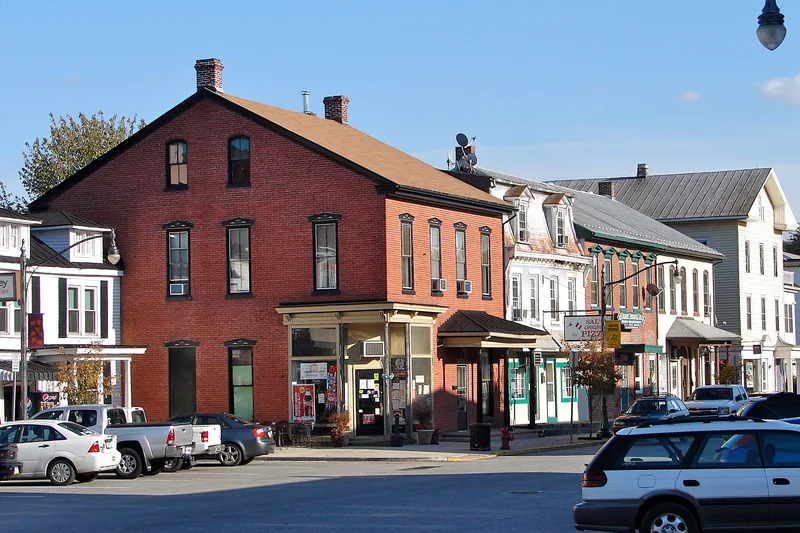
Newport is a river-town grid of about six by seven blocks in Perry County, Pennsylvania, with its commercial core at Center Square, where three-storey brick buildings occupy each corner. Its origins lie in a gristmill that David English built on Little Buffalo Creek around 1765, and the town grew as flour and feed were shipped by flatboat to Harrisburg and Baltimore. The Juniata Division of the Pennsylvania Canal reached it in 1830 and the Pennsylvania Railroad in 1849. The district is regarded as significant for its long-term commercial and industrial role, with tanneries, forges, garment factories and mills operating over more than a century. Most of the roughly 361 residences are two-storey I-houses built between 1865 and 1920, reflecting the town's late nineteenth-century prosperity. The 1871 Graham Hotel, the 1875 Butz Building and the 1876 Centennial Building anchor the square, and the Jones Warehouse on Front Street dates from about 1817.
Machine-generated summary. This summary was generated by a language model from the official nomination document and has not been reviewed line by line by an editor. It may contain errors. Check the source document before relying on any detail. Source: nomination document (PDF) · catalog entry. Generated October 2026 (model claude-haiku-5-5, prompt v1.1-2026-10-29).
| Period of significance | 1817-1948 |
|---|---|
| Styles | Late Victorian: Italianate, Second Empire, Queen Anne; vernacular I-house |
| Areas of significance | Architecture, Commerce, Industry |
| Acreage | 144 |
| Boundary source | NPS cultural-resource GIS polygon |
| Full listing page | Newport Historic District (property record) |
What listing means for this property
This is a historic district. Buildings within its boundary are either contributing (they add to the district's significance) or non-contributing. Owners of contributing income-producing buildings can claim the 20% federal rehabilitation tax credit; homeowners should look at state credits. National Register districts impose no design review by themselves; a local historic district ordinance, if one exists, does (the difference explained).
General information, not legal or tax advice. Rules change; confirm with your State Historic Preservation Office or a qualified adviser.