Newlin Mill Complex
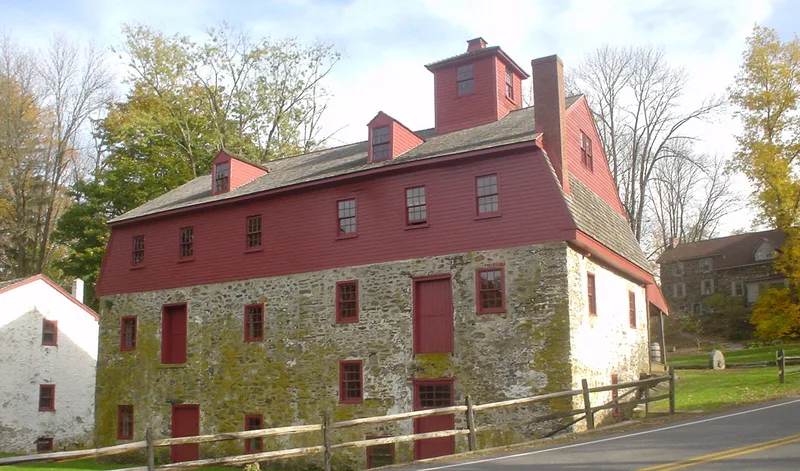

Why it's listed
Begun in 1704 by Nathaniel Newlin, an Irish Quaker who had reached Pennsylvania in 1683, this complex in Concord Township near Concordville centres on a water-powered grist mill beside Chester Creek. A datestone in the wall carries the 1704 date and the initials of Newlin and his wife. Nearby stand a two and one-half story warehouse, a rubble-stone Miller's House dated to 1739, a Trimble House built in two sections, and a Spring House from 1740 that was moved to the site. A railroad station linked the mill to Philadelphia and Baltimore markets. The mill ran until 1940 and was restored about fifteen years later. It is valued for its architecture and for tracing milling and commerce across a century and a half in a region of early mills. Two trees on the grounds are said to date from William Penn's time. The land is a non-profit historic park open to visitors.
Machine-generated summary. This summary was generated by a language model from the official nomination document and has not been reviewed line by line by an editor. It may contain errors. Check the source document before relying on any detail. Source: nomination document (PDF) · catalog entry. Generated October 2026 (model claude-haiku-5-5, prompt v1.1-2026-10-29).
| Period of significance | 1704-1870 |
|---|---|
| Styles | Victorian pointed or Gothic style (railroad station); Delaware County eighteenth century architectural style (mill and houses) |
| Areas of significance | Commerce, Architecture |
| Acreage | 5 |
| Boundary source | NPS cultural-resource GIS polygon |
| Full listing page | Newlin Mill Complex (property record) |
What listing means for this property
This is a historic district. Buildings within its boundary are either contributing (they add to the district's significance) or non-contributing. Owners of contributing income-producing buildings can claim the 20% federal rehabilitation tax credit; homeowners should look at state credits. National Register districts impose no design review by themselves; a local historic district ordinance, if one exists, does (the difference explained).
General information, not legal or tax advice. Rules change; confirm with your State Historic Preservation Office or a qualified adviser.