Little Buffalo Historic District

Why it's listed
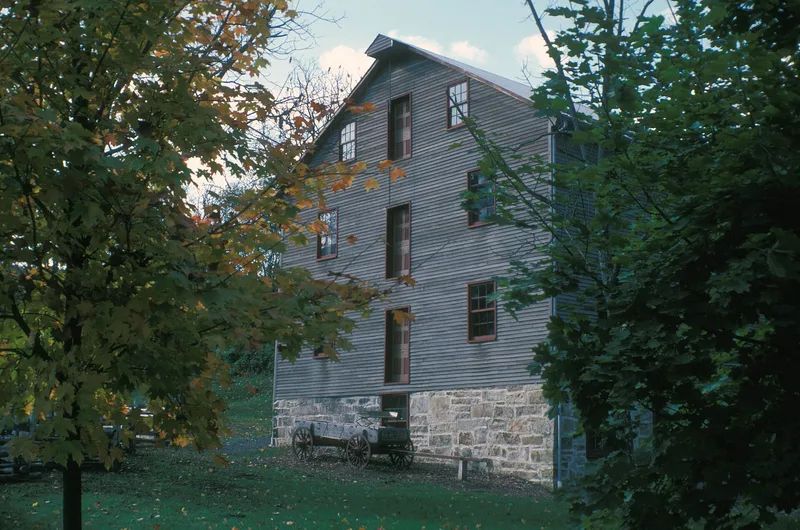
Little Buffalo Historic District lies in a valley between Middle Ridge and Buffalo Ridge, along Little Buffalo Creek in Perry County, Pennsylvania. Its origins lie in Juniata Furnace, an iron community established around 1808 when William Power and David Watts built a small furnace on Limestone Run, reputedly the first iron works in the county. The surviving features include Shoaff's Mill, begun around 1832 and completed by 1840, the ground-level section of the Blue Ball Tavern, several outbuildings, and a cemetery holding graves of members of the Gantt and Kough families. Later additions include a superintendent's house dated 1861 and a Burr arch covered bridge. The district's combination of early and late features, with few modern intrusions beyond a road, gives it a notable degree of integrity for the area and reflects the economic life of the region in the nineteenth century.
Machine-generated summary. This summary was generated by a language model from the official nomination document and has not been reviewed line by line by an editor. It may contain errors. Check the source document before relying on any detail. Source: nomination document (PDF) · catalog entry. Generated October 2026 (model claude-haiku-5-5, prompt v1.1-2026-10-29).
| Period of significance | 1800-1899 |
|---|---|
| Areas of significance | Industry, Architecture |
| Acreage | 45 |
| Boundary source | NPS cultural-resource GIS polygon |
| Full listing page | Little Buffalo Historic District (property record) |
What listing means for this property
This is a historic district. Buildings within its boundary are either contributing (they add to the district's significance) or non-contributing. Owners of contributing income-producing buildings can claim the 20% federal rehabilitation tax credit; homeowners should look at state credits. National Register districts impose no design review by themselves; a local historic district ordinance, if one exists, does (the difference explained).
General information, not legal or tax advice. Rules change; confirm with your State Historic Preservation Office or a qualified adviser.