Hulmeville Historic District

Why it's listed
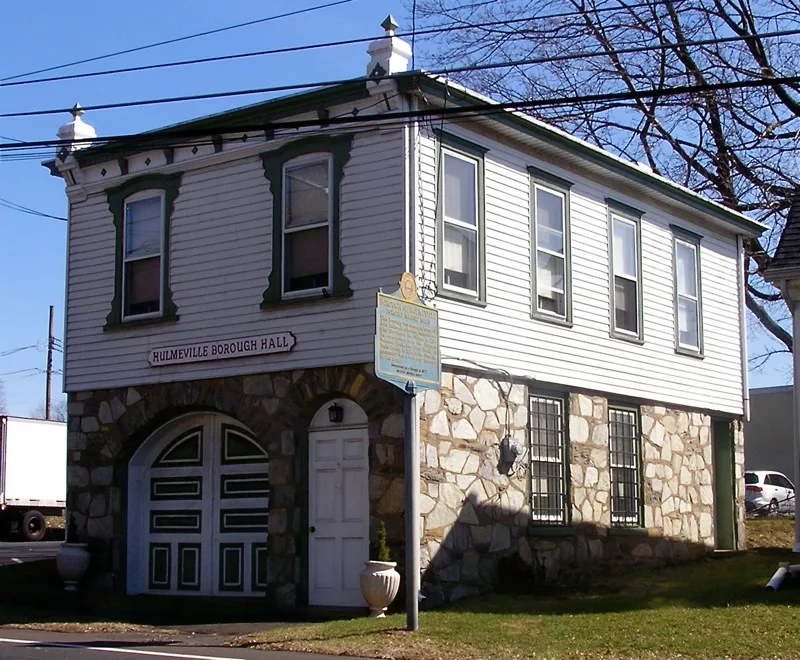
Hulmeville is a village of 119 resources in lower Bucks County, Pennsylvania, and its development began in 1792, when John Hulme started buying land and buildings in the mill settlement then called Milford Mills. Hulme and his sons assembled grist, oil, saw, fulling and tanning operations, a woolen factory, an inn, a store, a post office in 1809 and, in 1814, the county's first bank. Most buildings are modest vernacular houses from the late eighteenth to early twentieth centuries, showing details of Federal, Greek Revival, Victorian and Second French Empire styles, usually two and a half stories tall and set close to the sidewalk. Its importance rests on its role as a leading industrial and commercial center in the late eighteenth and early nineteenth centuries, when it rivaled New Hope and Morrisville in mills, and on its surviving collection of houses and shops. Johnson's Hall, an 1871 three-story Italianate building, and the Barkley Mill, built in 1880, are among its key landmarks. Residential growth slowed after 1920, leaving the village with a largely intact historic character.
Machine-generated summary. This summary was generated by a language model from the official nomination document and has not been reviewed line by line by an editor. It may contain errors. Check the source document before relying on any detail. Source: nomination document (PDF) · catalog entry. Generated October 2026 (model claude-haiku-5-5, prompt v1.1-2026-10-29).
| Period of significance | 1792-1920 |
|---|---|
| Styles | Vernacular with modest details of Federal, Greek Revival, Victorian and Second French Empire styles |
| Areas of significance | Industry, Commerce, Architecture |
| Acreage | 33 |
| Boundary source | NPS cultural-resource GIS polygon |
| Full listing page | Hulmeville Historic District (property record) |
What listing means for this property
This is a historic district. Buildings within its boundary are either contributing (they add to the district's significance) or non-contributing. Owners of contributing income-producing buildings can claim the 20% federal rehabilitation tax credit; homeowners should look at state credits. National Register districts impose no design review by themselves; a local historic district ordinance, if one exists, does (the difference explained).
General information, not legal or tax advice. Rules change; confirm with your State Historic Preservation Office or a qualified adviser.