Hays Bridge Historic District

Why it's listed
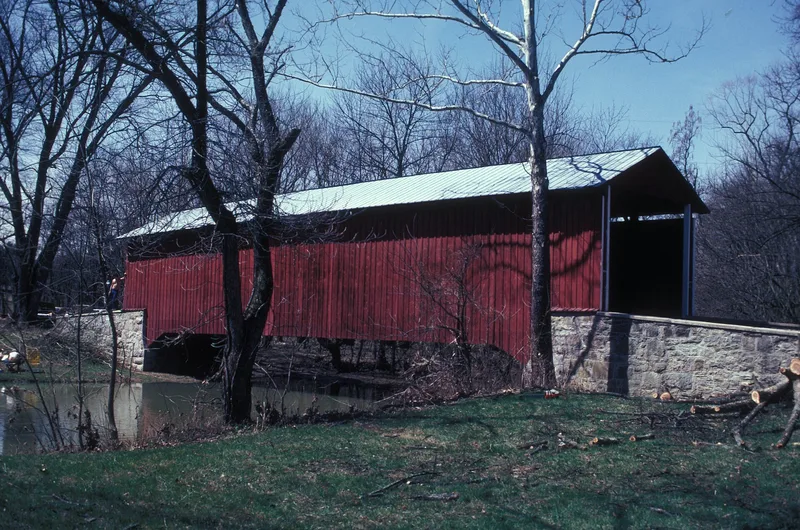
Near the meeting of Licking Creek and the West Branch of the Conococheague Creek, southeast of Mercersburg in Franklin County, Pennsylvania, the district centres on a three-bay-wide, three-story stone house built into a slope, probably in the latter part of the first quarter of the 19th century. Its two main-floor rooms each have a fireplace and a tightwinder staircase, and the attic floor carries a layer of lime and clay mortar about an inch thick, a treatment linked to 18th-century construction in southern Pennsylvania. A stone bank barn with German siding stands nearby amid a working apple orchard. Several hundred feet south, a double-arched stone bridge of about 100 feet carries Township Route 331 over the Conococheague, and to the southwest, a Burr truss covered bridge built in 1883 spans Licking Creek. The site is valued for its regional stone building tradition, its 19th-century bridge engineering, and its rural setting.
Machine-generated summary. This summary was generated by a language model from the official nomination document and has not been reviewed line by line by an editor. It may contain errors. Check the source document before relying on any detail. Source: nomination document (PDF) · catalog entry. Generated October 2026 (model claude-haiku-5-5, prompt v1.1-2026-10-29).
| Period of significance | early 19th century |
|---|---|
| Areas of significance | Agriculture, Engineering, Transportation, Architecture |
| Acreage | 9.9 |
| Boundary source | NPS cultural-resource GIS polygon |
| Full listing page | Hays Bridge Historic District (property record) |
What listing means for this property
This is a historic district. Buildings within its boundary are either contributing (they add to the district's significance) or non-contributing. Owners of contributing income-producing buildings can claim the 20% federal rehabilitation tax credit; homeowners should look at state credits. National Register districts impose no design review by themselves; a local historic district ordinance, if one exists, does (the difference explained).
General information, not legal or tax advice. Rules change; confirm with your State Historic Preservation Office or a qualified adviser.