Fairmount Avenue Historic District

Why it's listed
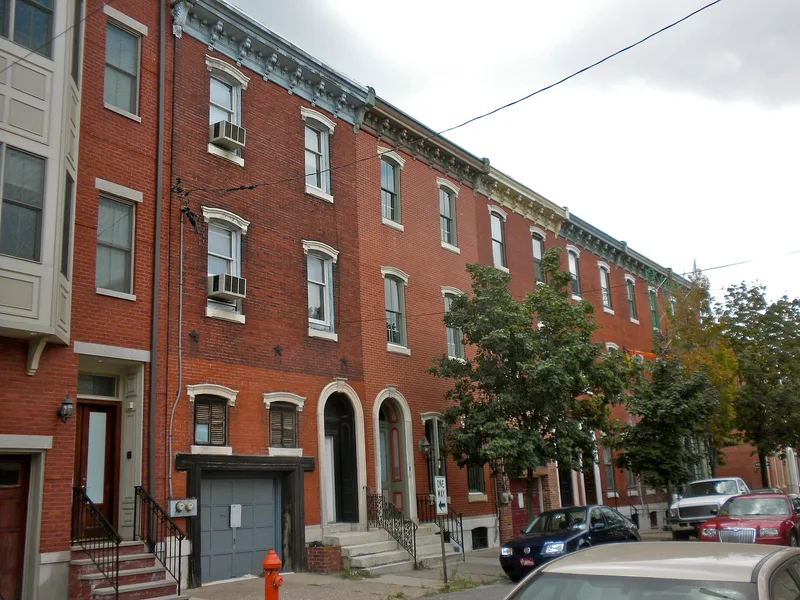
Mixed-use streetscape of 75 contributing buildings in north central Philadelphia, built mostly between about 1850 and 1930 along Fairmount Avenue and its service streets Melon and North. Three-story brick rowhouses with ground-floor stores from the 1850s through 1870s stand alongside Queen Anne rowhouses with brownstone trim at 1631-1637 Fairmount Avenue, and a buff brick rowhouse at 678 North 15th Street designed by Henry Dagit in 1891. The Bernot dye works at 1642-1644 Fairmount Avenue, designed by Baker and Dallett in 1900-1901, has a rounded corner and terrazzo floors. Later factories and showrooms from the 1910s and 1920s, including reinforced concrete workshops by Werner Trumbower at 1615-1627 Melon Street and the Art Deco automobile dealership at 1501-1505 Fairmount Avenue, reflect the rise of the automobile trade. The district is regarded as an intact example of the close mix of homes, workshops and shops that once characterized industrial Philadelphia neighborhoods.
Machine-generated summary. This summary was generated by a language model from the official nomination document and has not been reviewed line by line by an editor. It may contain errors. Check the source document before relying on any detail. Source: nomination document (PDF) · catalog entry. Generated October 2026 (model claude-haiku-5-5, prompt v1.1-2026-10-29).
| Period of significance | c. .1850-c.1930 |
|---|---|
| Styles | Late Victorian: Queen Anne, Second Empire; 20th Century Revival: Classical Revival; Modern Movement: Art Deco |
| Areas of significance | Industry, Architecture |
| Acreage | 20 |
| Boundary source | NPS cultural-resource GIS polygon |
| Full listing page | Fairmount Avenue Historic District (property record) |
What listing means for this property
This is a historic district. Buildings within its boundary are either contributing (they add to the district's significance) or non-contributing. Owners of contributing income-producing buildings can claim the 20% federal rehabilitation tax credit; homeowners should look at state credits. National Register districts impose no design review by themselves; a local historic district ordinance, if one exists, does (the difference explained).
General information, not legal or tax advice. Rules change; confirm with your State Historic Preservation Office or a qualified adviser.