Ehrhart's Mill Historic District

The National Park Service has not published a boundary polygon for this district; the map shows the listed properties inside it and the district's reference point.
Why it's listed
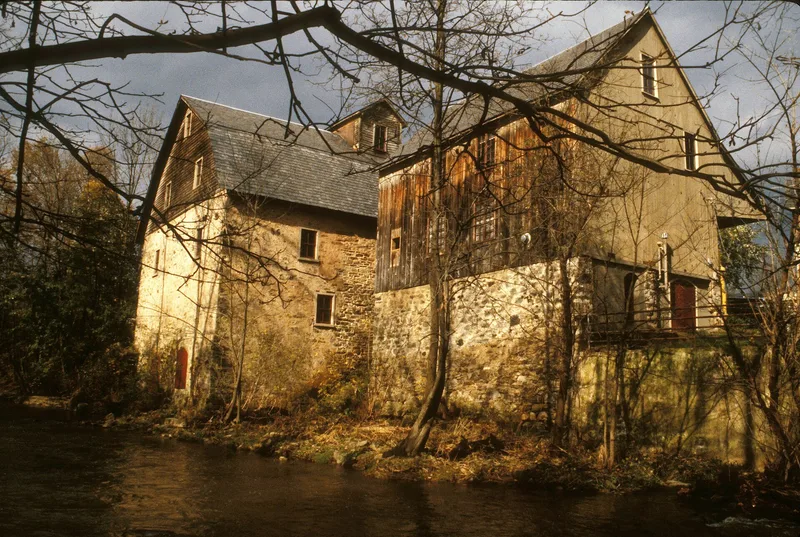
Along Old Mill Road beside Saucon Creek in Lower Saucon Township stands a cluster of nineteenth-century buildings centred on a limestone grist mill. The mill, rebuilt after a fire in 1865 under a gambrel roof, still holds three runs of mill stones, a 42-inch turbine that replaced an earlier water wheel around 1900, and most of its nineteenth-century milling machinery, which is rare among surviving local mills. The district also includes a mill house, a brick retirement house, a limestone farmhouse of about 1850, outbuildings, and an iron Pratt truss bridge completed in 1867. Its significance rests on that bridge, regarded as the earliest known iron Pratt truss bridge in Pennsylvania and a forerunner of a design later used widely across the state, and on the mill's unusually complete equipment. The houses, built by members of one family, are a locally notable mix of stone and brick construction.
Machine-generated summary. This summary was generated by a language model from the official nomination document and has not been reviewed line by line by an editor. It may contain errors. Check the source document before relying on any detail. Source: nomination document (PDF) · catalog entry. Generated October 2026 (model claude-haiku-5-5, prompt v1.1-2026-10-29).
| Period of significance | 1800-1937 |
|---|---|
| Areas of significance | Commerce, Engineering, Architecture |
| Acreage | 5.2 |
| Boundary source | not published |
| Full listing page | Ehrhart's Mill Historic District (property record) |
What listing means for this property
This is a historic district. Buildings within its boundary are either contributing (they add to the district's significance) or non-contributing. Owners of contributing income-producing buildings can claim the 20% federal rehabilitation tax credit; homeowners should look at state credits. National Register districts impose no design review by themselves; a local historic district ordinance, if one exists, does (the difference explained).
General information, not legal or tax advice. Rules change; confirm with your State Historic Preservation Office or a qualified adviser.