Troy Public Square

Why it's listed
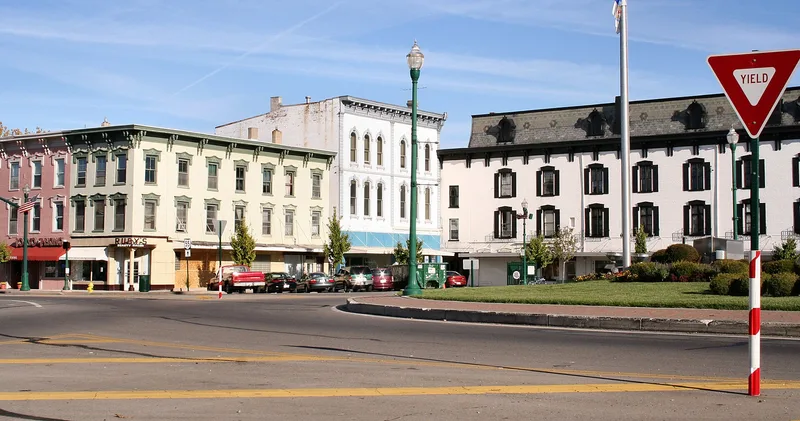
Troy Public Square is the commercial center of the county seat of Miami County, Ohio. Laid out in 1807 and 1808 on the highest ground in town, it was originally a courthouse square and now functions as a traffic circle with a small fountain park. The nominated district takes in buildings facing the Square and the streets running from it. Thirty-three buildings contribute to its character, and seven are classed as intrusions. Most are painted brick, with boxed cornices, friezes and brackets. Key buildings include the Mayo-Harter Building of about 1848, the Buckeye Building of 1847, the Second Empire Coleman-Allen Building, the Dye and Dunlap Buildings of about 1871, the Lollis Hotel of 1854 and the Bee Hive Corner of 1874. Mayo's Hall, Troy's first theater, opened in 1854. The district was listed as an unusually well preserved group of mid-nineteenth-century commercial architecture, with local hopes that its historic character could support the downtown economy.
Machine-generated summary. This summary was generated by a language model from the official nomination document and has not been reviewed line by line by an editor. It may contain errors. Check the source document before relying on any detail. Source: nomination document (PDF) · catalog entry. Generated October 2026 (model claude-sonnet-5-5, prompt v1.0-2026-10-29).
| Period of significance | 19th Century |
|---|---|
| Styles | Mid-Victorian commercial, including Italianate, Second Empire and Eastlake details |
| Areas of significance | Community Planning and Development, Commerce, Architecture |
| Acreage | 9.7 |
| Boundary source | NPS cultural-resource GIS polygon |
| Full listing page | Troy Public Square (property record) |
What listing means for this property
This is a historic district. Buildings within its boundary are either contributing (they add to the district's significance) or non-contributing. Owners of contributing income-producing buildings can claim the 20% federal rehabilitation tax credit; homeowners should look at state credits. National Register districts impose no design review by themselves; a local historic district ordinance, if one exists, does (the difference explained).
General information, not legal or tax advice. Rules change; confirm with your State Historic Preservation Office or a qualified adviser.