Oregon Historic District

Why it's listed
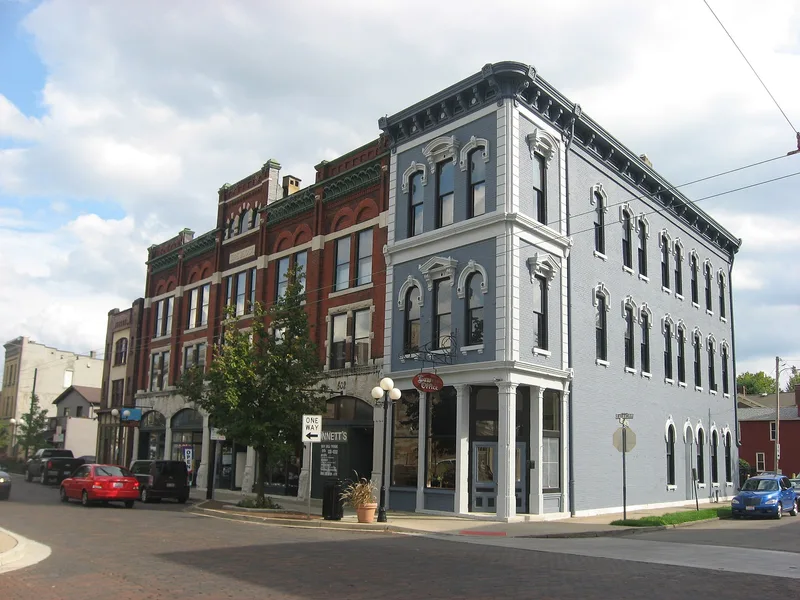
Oregon is a compact Dayton neighborhood east of the old Miami and Erie Canal, laid out beginning with a plat recorded in 1829. Its streets hold two-story brick houses with stone foundations, set close to the sidewalk on deep, narrow lots, and they show Dayton's architecture from about 1830 to 1908. Tecumseh Street has some of the city's earliest surviving buildings, including the 1842 Greek Revival Schaeffer House. Near Jackson Street stand grander homes, such as contractor John Butt's Italianate house of about 1864 and the 1877 Balsley mansion on Sixth Street. The district also records waves of settlement: Anglo-American founders, German artisans and merchants arriving from 1832, later Appalachian migrants, and more recent preservation-minded residents. After the 1913 flood and postwar decline, highway construction and urban renewal cut away nearly half the original area. Local support for preservation and a city architectural preservation designation halted planned demolition and encouraged restoration of the remaining blocks.
Machine-generated summary. This summary was generated by a language model from the official nomination document and has not been reviewed line by line by an editor. It may contain errors. Check the source document before relying on any detail. Source: nomination document (PDF) · catalog entry. Generated October 2026 (model claude-sonnet-5-5, prompt v1.0-2026-10-29).
| Period of significance | 1830-1905 |
|---|---|
| Styles | Greek Revival, early Victorian, Victorian Italianate, High Victorian, Eastlake-influenced Eclectic |
| Areas of significance | Industry, Commerce, Literature, Education, Architecture, Religion, Social History, Invention, Agriculture |
| Acreage | 60 |
| Boundary source | NPS cultural-resource GIS polygon |
| Full listing page | Oregon Historic District (property record) |
What listing means for this property
This is a historic district. Buildings within its boundary are either contributing (they add to the district's significance) or non-contributing. Owners of contributing income-producing buildings can claim the 20% federal rehabilitation tax credit; homeowners should look at state credits. National Register districts impose no design review by themselves; a local historic district ordinance, if one exists, does (the difference explained).
General information, not legal or tax advice. Rules change; confirm with your State Historic Preservation Office or a qualified adviser.