Miles Park Historic District

The National Park Service has not published a boundary polygon for this district; the map shows the listed properties inside it and the district's reference point.
Why it's listed
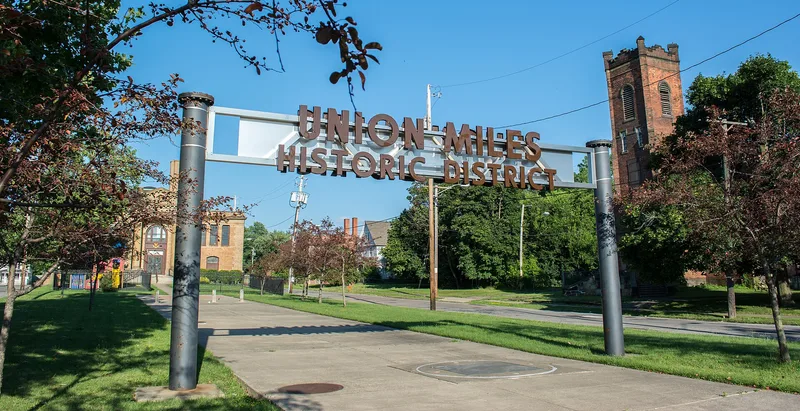
Miles Park is a small green in Cleveland's former village of Newburgh, surrounded by two churches, a Carnegie-funded library and eight modest houses. The district covers about 5.8 acres. When Newburgh was platted in 1850, space was reserved for a public square, and the land was given by pioneer Theodore Miles. The green took the name Miles Park in 1877. The Presbyterian church, built in 1872, is a late Romanesque Revival design in brick and stone. The Methodist church, a red brick High Victorian Gothic building, had its hall begun in 1872 and its sanctuary finished in 1883. Newburgh was annexed to Cleveland in 1873. The library, built between 1904 and 1906 with a $44,000 Carnegie grant, replaced the old town hall and is neo-Classic Revival with an octagonal domed reading room. The houses are typical working-class dwellings of the 1890s. The park remains remarkably intact, and with its buildings it reflects Newburgh's growth as a steel center.
Machine-generated summary. This summary was generated by a language model from the official nomination document and has not been reviewed line by line by an editor. It may contain errors. Check the source document before relying on any detail. Source: nomination document (PDF) · catalog entry. Generated October 2026 (model claude-sonnet-5-5, prompt v1.0-2026-10-29).
| Period of significance | 19th Century (specific dates 1850; 1872; 1883; 1906) |
|---|---|
| Styles | Neo-Classic Revival (library); Romanesque Revival (Presbyterian church); High Victorian Gothic (Methodist church) |
| Areas of significance | Architecture, Social History |
| Acreage | 5.8 |
| Boundary source | not published |
| Full listing page | Miles Park Historic District (property record) |
What listing means for this property
This is a historic district. Buildings within its boundary are either contributing (they add to the district's significance) or non-contributing. Owners of contributing income-producing buildings can claim the 20% federal rehabilitation tax credit; homeowners should look at state credits. National Register districts impose no design review by themselves; a local historic district ordinance, if one exists, does (the difference explained).
General information, not legal or tax advice. Rules change; confirm with your State Historic Preservation Office or a qualified adviser.